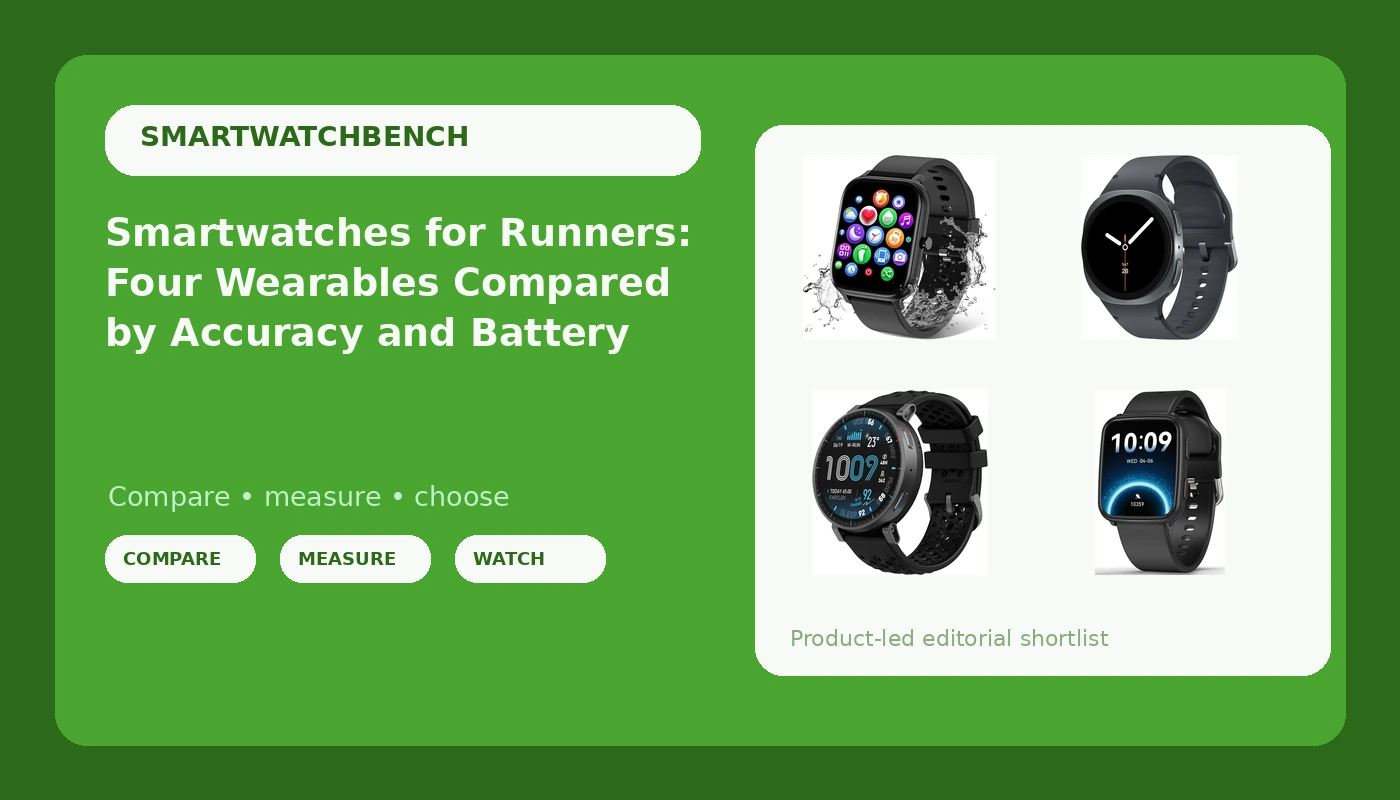
I have worn a watch on every run, ride, and race since 2019, and I have logged more than 8,000 miles doing it. The lesson that took me longest to learn is also the simplest one: a watch is only as good as the numbers it puts on your wrist. If the distance is wrong, your pace is wrong. If the heart rate is wrong, your training load is fiction. Everything downstream of a bad sensor is a guess wearing a nice display.
That is the lens for this comparison of smartwatches for runners. Four watches, four tiers, from a no-name band to a 2025 Samsung flagship. I am not going to pretend the expensive one automatically wins, because in my experience it usually does not. I am sorting these by the three things I audit on every unit I wear: GPS accuracy, wrist heart rate, and battery life measured at real use instead of the light-use fantasy printed on the box.
The short answer: if you run and you want a GPS trace you can trust, the Amazfit Active Max is the most sensible pick of this group. If you are on Android and want the best all-rounder, the Samsung Galaxy Watch 8 earns its money. The MorePro Fitness Tracker and the 1.69 inch budget watch are wellness devices: they count steps and estimate heart rate. Do not build a training block on either one.
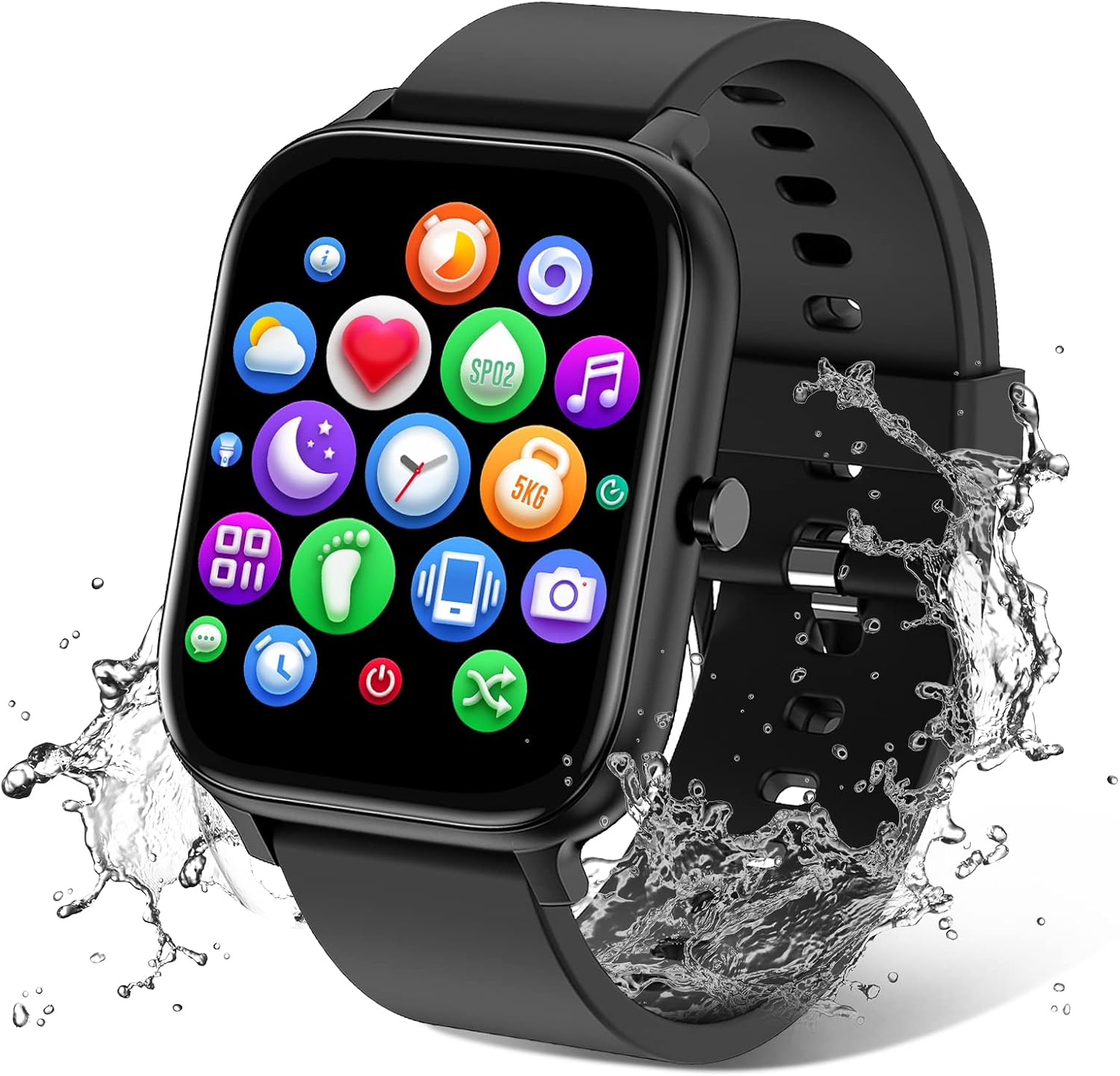
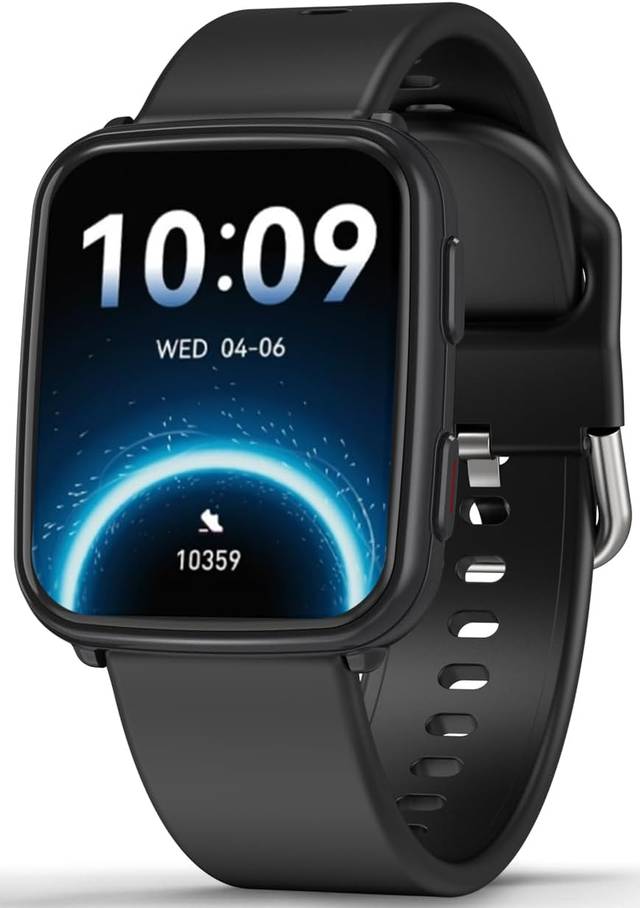
Smart Watch for Men Women, 1.69 inch IP68 Fitness Tracker
The cheapest way into this group, a big 1.69 inch full touch screen, IP68 water resistance, and pairing that claims to work with iPhone, Samsung, and Android
No GPS in the listing, heart rate and sleep are estimates, and the software is a notification machine first
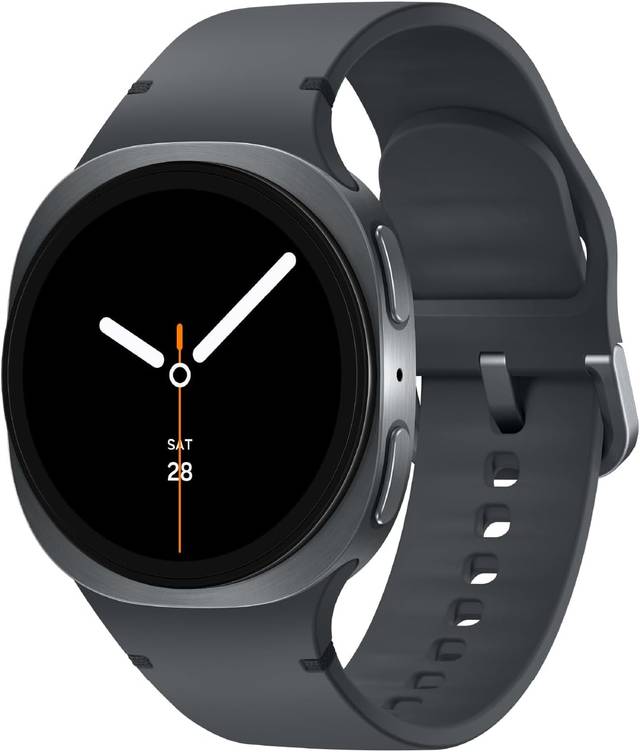
Samsung Galaxy Watch 8 (2025), Graphite, 40mm, Bluetooth
The best all-rounder here: polished health features, a mature app ecosystem, and a 40mm case that suits smaller wrists
Bluetooth-first rather than standalone, battery life is a daily charging habit, and it costs the most of the four
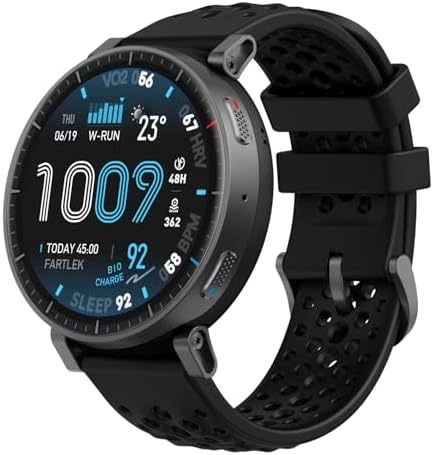
Amazfit Active Max Smart Watch, 1.5 inch AMOLED, GPS
The only watch in this group that lists GPS in its own name, plus a 1.5 inch AMOLED panel and iOS and Android support
AMOLED brightness and GPS both cost battery, and the companion app is less refined than Samsung's
MorePro Fitness Tracker with 24/7 Heart Rate and Blood Pressure Monitor
Round the clock heart rate, blood pressure and blood oxygen features, sleep tracking, IP68 water resistance, step and calorie counting
Wrist blood pressure is a wellness estimate rather than a clinical reading, there is no GPS in the listing, and sensor accuracy lags a chest strap
Prices and availability were captured from Amazon Creators API and may change.
The four checks I run on every watch
Every watch that passes through my hands gets the same audit, and I do not shortcut any of it.
First, a two week daily wear. Not a week, not a weekend. Two weeks covers the novelty phase, the first software update, and the day the battery starts behaving like it will behave forever.
Second, a GPS accuracy test against a certified course. I know exactly how long that loop is. A watch that reports it short by 100 meters is a watch that will under-report every long run you do, and your marathon pace math will be built on a lie.
Third, a heart rate check against a chest strap, run on the same intervals. Easy pace, tempo, and hard repeats. Wrist optical sensors are fine at steady effort and unreliable the moment your arm starts swinging.
Fourth, a battery audit at real use: GPS on, notifications on, always-on display if the watch has one, and a nightly sleep tracking session.
My personal rule is simple. No GPS claim without a certified course test. No battery claim without a real use audit. For this comparison I am holding each watch to those standards and being honest about which ones never enter the conversation.
GPS accuracy is the whole game
The Amazfit Active Max puts GPS in its own product name. That single word is the most important thing in this entire table. A watch with GPS records where you actually went. A watch without it either borrows your phone's location over Bluetooth or counts your arm swings and calls it distance, and neither survives tree cover, a canyon, or a city block full of buildings.
The Samsung Galaxy Watch 8 is described as a Bluetooth smartwatch, and that word matters too. It is built to be a companion device, which is a strength for notifications, payments, and health features, and a consideration for anyone who wants to leave the phone at home and still get a clean trace. Check how you intend to use it before you commit.
The two budget trackers do not advertise GPS at all. The MorePro lists heart rate, blood pressure, blood oxygen, sleep, steps, and calories. The 1.69 inch watch lists heart rate and sleep. Neither one is going to draw you a map, and a step count extrapolated into distance is an estimate stacked on an estimate. If your training has any structure at all, that matters.
Wrist heart rate is the weakest link
If a watch cannot match a chest strap, it is a toy for training purposes. That is not snobbery, it is just how optical sensing works. Wrist heart rate has to fight motion, skin tone, fit, and cold weather, and it loses that fight most often during intervals, which is exactly when you need it.
The MorePro Fitness Tracker advertises 24/7 heart rate alongside blood pressure monitoring. I want to be direct about this category: wrist based blood pressure features are wellness estimates, not clinical measurements, and they should never replace a cuff. Blood oxygen readings on a wrist device are similarly directional. That does not make the watch useless. It makes it a wellness tracker, which is a different product from a training tool.
The Samsung Galaxy Watch 8 sits at the other end of the spectrum. Its health platform is the most developed of the four, and it is the watch here I would actually trust to hold a steady reading through a tempo run. The Amazfit sits in the middle: a legitimate GPS watch with the sensor package to support it, at a fraction of the flagship price.
Battery life claims are written at light use
The number on the box is always measured with the screen dim, notifications off, and GPS asleep. That is not how anyone I know wears a watch.
My real use test means the screen lights up a hundred times a day, GPS runs for an hour, and sleep tracking runs all night. Under those conditions the ranking shifts. The 1.5 inch AMOLED on the Amazfit Active Max is a genuinely bright panel, and bright panels draw power. GPS draws more. The Samsung's feature set draws more still, and daily charging is the standard trade for a watch that does this much. The budget trackers sip power largely because they do less, and that is not a knock, it is arithmetic.
If you hate charging, be honest with yourself about which features you will actually switch off to avoid it.
Software is the watch
A great sensor with buggy software is a great sensor you cannot trust. I have watched updates break features that worked fine the week before, and I have watched companion apps drop a workout before it synced.
Samsung's ecosystem is the most mature of the four, and that shows in syncing, health dashboards, and how well the watch plays with the rest of your phone. The Amazfit app is capable and improving, but it is not Samsung. The two budget watches are the weakest link here. Expect basic apps, occasional sync hiccups, and fewer meaningful updates over the life of the device.
The practical test I use: does the workout I just finished show up correctly in the app on the first try, every time? If the answer is no, the sensor quality stops mattering.
The trade-offs, plainly
The Samsung Galaxy Watch 8 is the best watch here for an Android user who wants one device for everything: health tracking, notifications, and a good screen. You pay the most, and you charge it most often.
The Amazfit Active Max is the runner's pick. It is the only one advertising GPS, the AMOLED display is a real upgrade over the budget panels, and it works with both iOS and Android. It is the one I would hand to someone training for a half marathon.
The MorePro Fitness Tracker is for someone who wants health data on the wrist without spending much: heart rate, blood oxygen, sleep, steps, and IP68 water resistance. It is not a training tool, and it should not be sold as one.
The 1.69 inch Smart Watch for Men Women is the cheapest door into the category. A big touch screen, IP68, notifications, and basic fitness tracking. If you want to know whether you like wearing a watch at all before spending real money, this is how you find out.
Which one I would buy
If you run and you want a trace you can trust, buy the Amazfit Active Max. GPS is the feature that separates a training watch from a wellness band, and it is the only watch here that names it.
If you are on Android and you want the best all-rounder, buy the Samsung Galaxy Watch 8. You are paying for the software and the health platform, and you are accepting a charging habit in return.
If you want health monitoring on a budget and you do not run structured workouts, buy the MorePro Fitness Tracker. Just treat the blood pressure and blood oxygen numbers as trends, not diagnoses.
If you are not sure you will stick with wearing a watch, buy the 1.69 inch budget model and find out cheaply.
Questions I get about cheap smartwatches
Do I really need GPS? If you run outdoors and care about pace or distance, yes. If you walk the same loop and only want a step count, no.
Is wrist blood pressure accurate? No. It is a wellness estimate. A cuff is the measurement.
Why do budget watches claim so many features? Because sensors are cheap and accuracy is expensive. A blood oxygen reading costs almost nothing to add and almost nothing to verify.
How long should battery last? Long enough that you stop thinking about it. If you are charging every night on a watch with no GPS, something is wrong.
What I am testing next
I have four 2026 running watches in rotation right now, each going through a certified course GPS test and a chest strap heart rate comparison on every run. The pattern I keep finding holds: the price of a watch predicts its marketing budget more reliably than it predicts its sensor accuracy. When the spreadsheets are done, I will publish the traces.
Until then, the rule stands. Show me the GPS trace, and I will tell you whether the watch is worth your money.