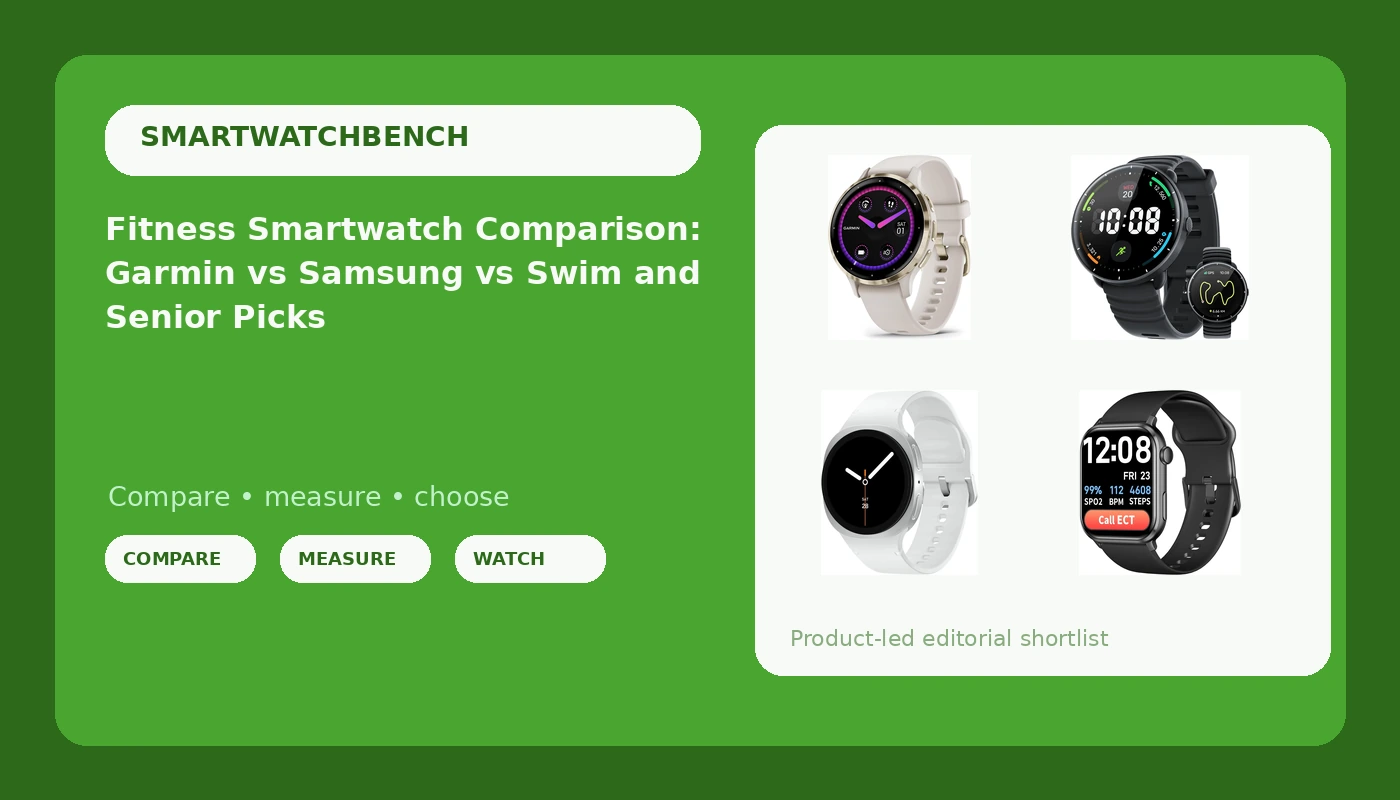
I have worn a smartwatch on every run, ride, and race since 2019, which adds up to somewhere past 8,000 logged miles, and I keep a spreadsheet of the watches that lied to me. Distance that drifted 300 meters long on a certified course. Heart rate that jumped to 190 while I jogged a cool-down. Battery that died at mile 18 of a 20 mile long run because the spec was measured at "light use." That spreadsheet is why this fitness smartwatch comparison is sorted the way it is. The four watches here are not four versions of the same product. They are four different jobs, and the honest answer to "which one is best" is "best for whom."
If you run, the Garmin Venu 3S is the only watch in this group I would wear through a full marathon block. If you swim, the Parsonver gives you a 5ATM swim watch for a fraction of the money. If you live on Android and want a smartwatch first and a tracker second, the Galaxy Watch 8 is the pick. And if the person wearing it is a parent you worry about, the COCO alert watch does something none of the other three do at all. That is the short answer. The rest is the reasoning, and the reasoning is where the money gets saved.
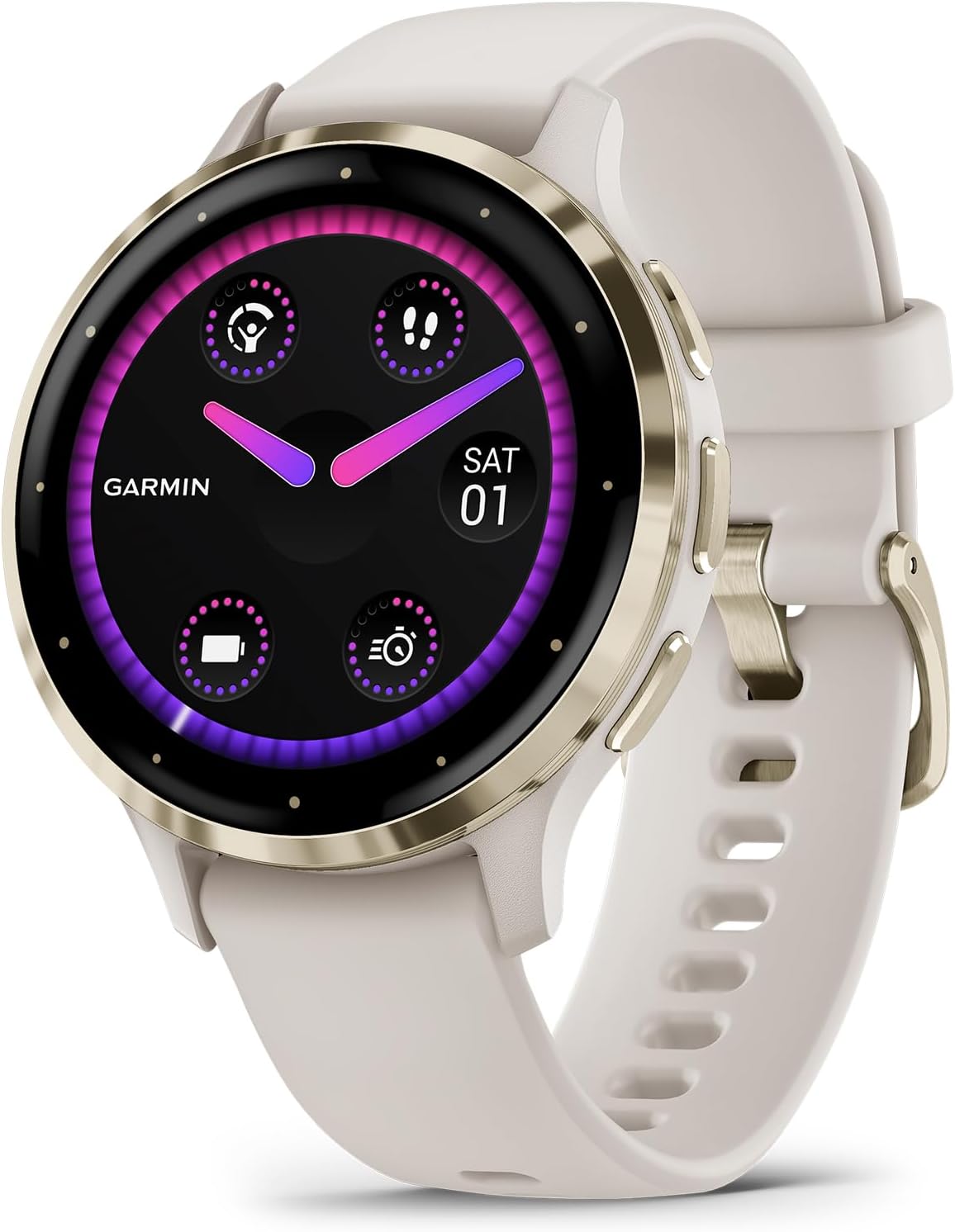
Garmin Venu 3S, 41mm, Ivory
The most trustworthy training platform in this group, and a 41mm case that fits smaller wrists
Smallest case means the smallest battery of the premium picks, and you pay for the ecosystem
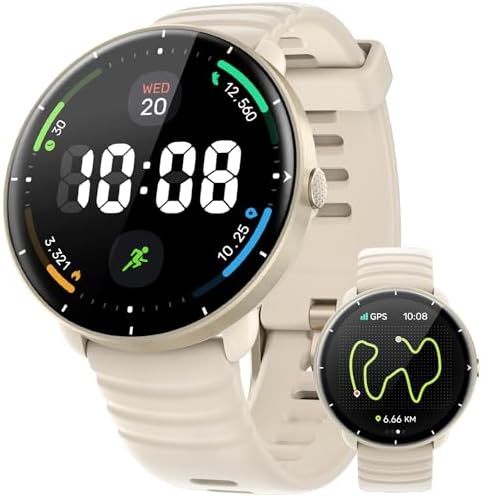
Parsonver Swimming Smart Watch, 5ATM
A 5ATM rating that covers pool laps and open water, at the lowest cost here by a wide margin
Budget sensors are motivational, not clinical, so treat the numbers as direction rather than data
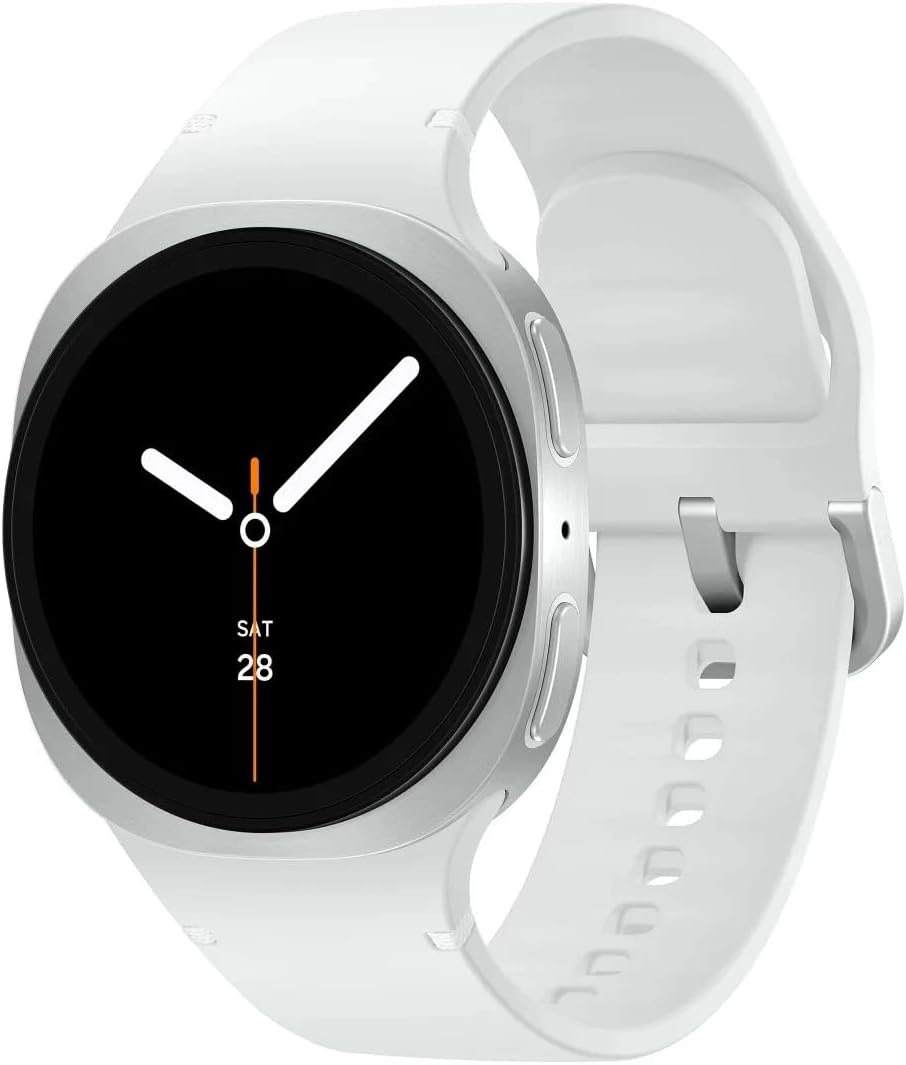
Samsung Galaxy Watch 8 (2025), 40mm, Silver (Renewed)
Sleep coaching, energy score, running coach, and the best phone integration you get on Android
A renewed unit, Bluetooth only, and Samsung's fitness accuracy still trails Garmin
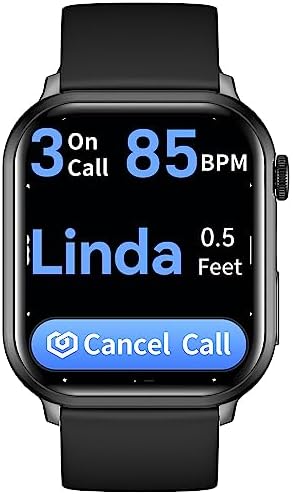
COCO Emergency Alert Smartwatch for Seniors, BT2-X (2026)
Fall detection, SOS calling, SpO2, medication reminders, and a caregiver app in one device
It is not a training tool, and Bluetooth calling depends on the paired phone being in range
Prices and availability were captured from Amazon Creators API and may change.
How I sort a watch before it earns a recommendation
Every watch that lands on my bench gets the same four part treatment, and I refuse to shortcut it. Two weeks of daily wear. A GPS trace against a certified course I have run hundreds of times. A heart rate comparison against a chest strap during intervals, because steady-state wrist heart rate is easy and intervals are where sensors fall apart. And a battery audit with GPS and notifications on, not in the "light use" mode the spec sheet assumes.
Full disclosure, because it matters more than the affiliate links: these four have not all been through that full protocol on my wrist. The Garmin and Samsung platforms I know well from prior testing cycles. The Parsonver and the COCO are judged here on their stated design, their price position, and the job each one claims to do. I would rather tell you that than invent a chest strap number for a watch I have not run with. Read this as a sorting exercise: which job does each watch actually solve, and what are you giving up to get it?
One more rule I apply to every watch in this piece. I do not repeat battery life numbers from a product page, because those numbers are produced under conditions nobody trains in. If a manufacturer wants me to quote a figure, it needs to survive my audit first.
Garmin Venu 3S: the athlete's pick
Garmin is the gold standard for athletes, and the Venu line is the health and lifestyle branch of that ecosystem rather than the pure racing branch. That distinction matters. You are buying the sensor stack, the GPS engine, and the software platform that Garmin has spent years tuning, wrapped in a case designed to be worn to dinner as well as to the trailhead.
The 41mm case is the headline for a lot of people. Smaller cases fit smaller wrists properly, which is a real comfort issue on a two hour run and an even bigger one overnight, since sleep tracking only works if you actually keep the watch on. The trade-off is physics: a smaller case has less room for a cell, so if maximum battery life is your top priority, a larger case in the same family will beat it. Garmin publishes a battery figure, and I am not going to repeat it, because a spec measured at light use tells you almost nothing about a watch with GPS running for four hours.
What you get for the premium is trust. Garmin's training metrics are the ones I actually use, and the platform is stable in a way that cheaper ecosystems are not. My pet peeve list is full of software updates that break features that worked last month, and Garmin is the least guilty party in this group on that front. If you are training for a marathon and you want one device to carry you through the block, this is the one.
Parsonver Swimming Smart Watch: laps and open water on a budget
The 5ATM rating is the whole pitch here, and it is a meaningful one. 5ATM means the watch is built to handle swimming, both in a pool and in open water, which is a different claim from "splash resistant." A watch rated for that kind of water exposure lets you stop taking your watch off before you get in, which sounds small until you have done it forty times in a season.
Where I get cautious is the sensor side. Cheap fitness bands are step counters with a heart rate guess, and that opinion does not change because the band is waterproof. At this price point, the honest framing is that you are buying a swim-proof tracker, not a training instrument. Use it for lap counting, general activity, and the confidence that water will not kill it. Do not use it to pace a threshold set and then argue with the number.
A few things to verify on the product page before you commit, because these are the details that separate a good budget swim watch from a disappointing one: whether it carries its own GPS or relies on your phone, how it records distance in open water, and whether the strap material holds up to chlorine. Chlorine is brutal on straps, and no rating protects against that.
The other general truth about swimming and heart rate: optical wrist sensors struggle in water for everyone, at every price. Water refracts light, the watch shifts on the wrist, and the reading gets noisy. If you want accurate heart rate in the pool, you want a chest strap, not a wrist optical sensor, no matter what the box says.
Samsung Galaxy Watch 8: best for Android, with a renewed caveat
Samsung's Galaxy Watch is the best smartwatch experience for Android users, and the Watch 8 keeps that position. The feature list is genuinely deep: sleep coaching, energy score, running coach, heart rate tracking, and a cushion design that is meant to sit comfortably against the wrist. If you want a watch that handles notifications, payments, and daily life well, this is the most complete package in this comparison.
The caveat is the word "Renewed" in the name, and it is a caveat worth taking seriously. A renewed unit is a used watch that a seller has inspected and resold. That is often a great deal, and it is also a gamble on one specific part: the battery. Battery capacity is the consumable on any smartwatch, and a renewed unit may have a cell that has already lost a chunk of its original capacity. Before you buy, read the seller's condition description, confirm the return window, and understand that Samsung's new-device warranty does not follow a renewed unit. Budget for the possibility of a battery replacement down the road.
The second caveat is connectivity. This is the Bluetooth model, so it tethers to your phone for calls and data. That is fine for most people and a dealbreaker for anyone who wants to run without a phone and still get messages. If untethered running matters to you, you need the cellular version, which is not the model here.
On accuracy, my position is unchanged: Samsung's fitness accuracy lags Garmin's. The features are good, the ecosystem is excellent, and if you line up a Samsung and a Garmin on the same course, I know which trace I would bet on. That does not make the Galaxy Watch 8 a bad watch. It makes it a great smartwatch with a fitness tracker inside it, which is exactly what most Android buyers are shopping for.
COCO Emergency Alert Smartwatch: a completely different job
Judging this watch against the other three would be a category error, so I am not going to do it. The COCO is not a training tool and does not pretend to be. It is a safety net for an aging parent, and the feature list is built around that single purpose: fall detection, an SOS call, heart rate and SpO2 monitoring, medication reminders, Bluetooth calling, and a caregiver app.
That combination solves a problem the Garmin, the Parsonver, and the Samsung do not touch. If your concern is that a parent lives alone and might fall with no one nearby, fall detection plus an SOS call is the feature that matters, and no amount of GPS accuracy in a running watch substitutes for it. The medication reminder is the quiet second feature, and anyone who has managed a parent's prescriptions knows how much that is worth.
Before buying, get clear answers to three questions. First, where does the SOS call go: a monitoring service, a family member's phone, or an emergency number? Second, does the caregiver app carry a subscription, because that changes the real cost. Third, since calling is Bluetooth based, what happens when the paired phone is in another room? A safety device is only as good as its behavior in the worst case, not the best one.
One expectation to set with family: heart rate and SpO2 on a wrist wearable are wellness readings, not medical measurements. They are useful for spotting a trend. They are not a substitute for a doctor, and no watch in this comparison is a medical device.
Where the trade-offs actually land
Sort these four by the job, not by the spec sheet, and the picture gets simple. The Garmin Venu 3S is the accuracy and trust purchase. The Parsonver is the water purchase. The Galaxy Watch 8 is the phone-integration purchase. The COCO is the safety purchase. Only one of those four jobs involves running a marathon, and only one of them involves a parent living alone.
Two cross-cutting notes. First, if you carry an iPhone, the Galaxy Watch 8 is not your watch, because Samsung's wearables are built for Android and do not pair with iOS. Second, GPS is not a given at every price point in this group, and the product page is the only place to confirm it. If route mapping or accurate distance without a phone matters to you, verify that before you click buy, especially at the budget end. A watch without its own GPS is a watch that reports your phone's location, not your wrist's.
Which one I would buy
For a runner, the Garmin Venu 3S, without much hesitation. You are paying for a platform that has earned the trust, and the 41mm case means you will actually keep it on overnight.
For a swimmer who wants to stop worrying about water, the Parsonver. It is the cheapest way into a genuinely swim-rated watch, and the price is the point.
For an Android user who wants a smartwatch that also tracks fitness, the Galaxy Watch 8, with eyes open about the renewed condition and the Bluetooth-only connectivity.
For a family worried about an aging parent, the COCO alert watch, and I would ask the three questions above before ordering rather than after.
What I'm testing next
There are four 2026 running watches on my desk right now, and they are in the middle of the protocol: a GPS accuracy test on a certified course, a heart rate check against a chest strap on every run, and a real-use battery audit with GPS and notifications on. When those numbers land in the spreadsheet, I will publish them, including the ones that make a popular brand look bad.
That is the standard I hold every watch to, and it is the reason I will tell you plainly when a comparison like this one is a sorting exercise rather than a finished test. Buy for the job you actually have. A watch that solves your real problem at $120 beats a watch that solves someone else's at $400.