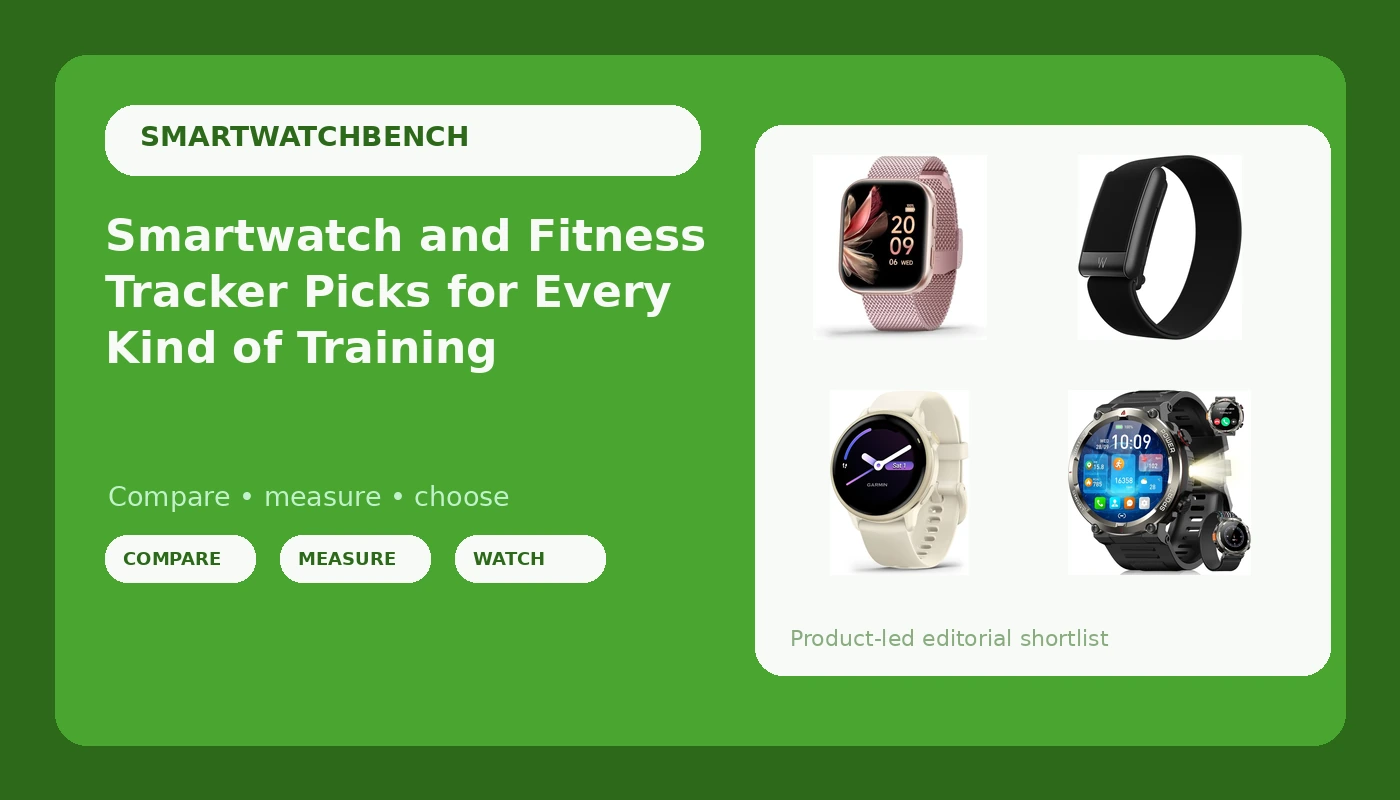
Choosing a wearable in 2026 means sorting through two product categories that share a wrist strap. A smartwatch and fitness tracker can both count your steps and read your pulse, but they are built around different assumptions. One assumes you want a screen, calls, and apps on your wrist. The other assumes you want the sensor data to disappear into a coaching app and leave you alone. The problem for a buyer is that marketing copy flattens both into the same list of bullets, and the numbers on the box, whether battery days, sport modes, or heart rate zones, rarely describe what the device is actually like to live with.
This guide looks at four wearables that sit at four different points on that spectrum, from a low-cost tracker with a long feature list to a GPS watch built around outdoor positioning. It is not a ranking. It is a map of what each one is designed to do, so you can match the device to the way you actually move.
Related: How to Test GPS Accuracy on Any Running Watch →
Quick answer
If you want one screen on your wrist that handles calls, notifications, workout modes, and overnight health tracking without a subscription, the FITVII Health & Fitness Tracker covers the widest set of everyday features at the lowest entry point of the four. If recovery and coaching matter more to you than a display, the WHOOP 5.0/MG bundles a 12 month membership and puts its effort into software. If you need GPS you can trust on a measured course, the Garmin vívoactive 6 is the option here built around outdoor positioning. And if the watch has to survive job sites, trailheads, and cold mornings, the Military Smart Watch is the rugged pick.
Four useful options
| Model | Best fit | What stands out |
|---|---|---|
| FITVII Health & Fitness Tracker | Everyday wear and first-time buyers | Call answering, 24/7 heart rate, blood pressure and blood oxygen monitoring, sleep tracking, 120+ sport modes |
| WHOOP 5.0/MG | Recovery-focused athletes | 12 month membership, 24/7 activity and sleep tracking, personalized coaching, menstrual cycle insights |
| Garmin vívoactive 6 (42mm, Bone) | Runners, cyclists, and hikers | GPS positioning inside a health and fitness smartwatch |
| Military Smart Watch | Rough outdoor and trade work | Flashlight, compass, two straps, maker-rated 100 day battery |
The everyday all-rounder: FITVII Health & Fitness Tracker
The honest framing for this category is that a long feature list is not the same as accuracy. Optical wrist sensors at this price point are fine for resting heart rate and all-day trends, and they are the weakest link during hard intervals, when your pulse changes faster than the sensor can follow. Blood pressure and blood oxygen features on wrist wearables are generally wellness readings rather than clinical measurements, and no consumer wearable should be treated as a substitute for a medical device. What this watch does well is coverage: it gives you a screen, notifications, calls, sleep data, and a workout menu in one place, and it does not ask for a monthly fee. If your goal is a general health picture and a watch you can answer a call on, that is a reasonable trade. If your goal is a number you can build a training plan on, keep reading.
The coaching-first tracker: WHOOP 5.0/MG Activity Tracker
The trade here is straightforward and worth stating plainly. You give up the screen, the call answering, and the at-a-glance pace readout, and in return you get a device that pushes you toward recovery and readiness rather than toward a lap split. That suits people whose training is already structured and who want a daily signal about whether to push or back off. It suits runners less well if they want to glance at pace mid-run without pulling out a phone. It is also worth understanding the membership model before you buy: this is a subscription-shaped product, and the included 12 month term is part of what you are paying for, so factor the renewal into your long-term cost rather than judging the purchase on the hardware alone. As for the battery figure, 14+ days is a maker rating, and ratings in this category are usually measured at light use, which means the number you see in daily wear with continuous tracking will depend on how much you ask of it.
The GPS training watch: Garmin vívoactive 6
If distance accuracy is the thing you care about, this is where the money goes. A GPS watch records a trace you can compare against a known course, which is the only way to know whether the distance it reports is real. That matters more than any recovery score if you race, if you train by pace, or if you ride routes where a couple of hundred metres of error changes how you read the session. The 42mm case is also a practical detail: smaller watches tend to sit more securely on the wrist, and a watch that slides around will produce worse optical heart rate data than a watch that stays put. The other side of the trade is price. This is the most expensive option in the group by a wide margin, and much of what you are buying is the positioning hardware and the platform around it. If you never leave the pavement or the treadmill, that premium is harder to justify.
The rugged outdoor watch: Military Smart Watch for Men
Treat the 100 day battery figure the way you would treat any battery claim in this category: as a rating produced under specific conditions, most likely standby or light use. A watch doing continuous heart rate tracking, notifications, and workout recording will not match that number, and the gap can be large. What makes this watch interesting is everything else in the package. A built-in flashlight and a compass are genuinely useful in the field, and they are features the other three options here do not offer at all. Two straps in the box means you can swap between a work strap and something lighter without buying an accessory. The honest limitation is that rugged construction does not equal training-grade measurement. If you want a device that survives a rough week and tells you roughly how active you were, this is a sensible pick. If you want a heart rate trace you can compare against a chest strap, look at the Garmin instead.
Prices and availability may change. Product images, names, and retailer links are matched to verified listings. No current price, rating, stock status, or measured result is stated here without current evidence.
What the spec sheet does not tell you
Three numbers decide whether a wearable is worth wearing, and none of them are on the box.
The first is GPS accuracy. A watch that cuts corners on tree-covered trails will report a shorter distance than you ran, and it will do it consistently, which is worse than being randomly wrong because you will not notice. The only way to check is to run a course you know the length of and compare the trace. If the watch is off by 100 metres over a 10 kilometre route, every pace and every training load number built on top of that distance is off too.
The second is heart rate accuracy during hard efforts. Optical wrist sensors work by shining light into the skin and watching how blood volume changes, which is a fine method at rest and a difficult one when your heart rate is jumping between 140 and 180 in a minute. Wrist heart rate tends to lag and to spike during intervals. That is not a defect in one brand, it is the physics of the sensor. A chest strap remains the reference, and any watch claim about heart rate zones is only as good as the underlying signal.
The third is battery life, and this is where marketing language does the most work. Ratings are commonly produced at light use, which may mean limited notifications, no continuous tracking, and no GPS sessions. Real use with GPS and notifications on will draw down the battery faster. When you compare two watches, compare the conditions behind the numbers, not just the numbers.
How to match a wearable to your training
- Write down the three things you will actually do with it. If they are "answer calls, check sleep, count steps", a general tracker is enough. If they are "run intervals, ride routes, hike", you need positioning and a strap-comparable heart rate.
- Decide whether you want a screen. A display means at-a-glance pace and notifications, and it costs battery. No display means fewer distractions and a device that stays out of the way, but you will reach for your phone mid-run.
- Check the membership terms. A bundled subscription changes the true cost of ownership across several years, and that matters more than the initial listing figure.
- Match the case size and strap to your wrist. A watch that moves during a run produces worse optical data, and two straps in the box can solve a fit problem without extra spending.
- Set a budget that reflects your sport, not your ambitions. A low-cost tracker used for walking and sleep is good value. The same watch used to pace a marathon is the wrong tool, and no amount of features fixes that.
Practical guidance before you buy
- Wear any new watch for a week before you judge it, and check resting heart rate against a manual pulse count at least once.
- Run one route you know the exact length of and compare the recorded distance before you trust pace data.
- Turn off notifications for a day and note how much battery you recover, which tells you what your real daily drain looks like.
- Check that the app you will live in works on your phone platform, since call answering and notifications depend on that pairing.
- Expect sensor readings to be directional rather than clinical, and treat blood pressure and blood oxygen features as wellness indicators.
Which option should you choose?
Choose the FITVII Health & Fitness Tracker when you want the widest everyday feature set, including calls and overnight health tracking, without a subscription. Choose the WHOOP 5.0/MG Activity Tracker when recovery and coaching matter more to you than a screen, and you are comfortable with a membership-shaped product. Choose the Garmin vívoactive 6 when you train outdoors and need distance and positioning you can verify against a known course. Choose the Military Smart Watch for Men when durability, a flashlight, and a compass matter more than training-grade measurement.
One caveat applies to all four. The feature lists here come from the product records, and nothing in this guide is a measured verdict on any individual unit. Battery ratings are manufacturer figures produced under conditions that are rarely stated in full, optical heart rate is a convenience sensor rather than a chest strap, and wrist blood pressure and blood oxygen readings are not clinical measurements. Verify the current listing details yourself before you commit, and judge the watch against the sport you actually do rather than the one you plan to start.
The bottom line
These four wearables are not competing for the same wrist. The FITVII covers the most ground for the least commitment, the WHOOP 5.0/MG trades a screen for coaching and recovery insight, the Garmin vívoactive 6 puts its budget into GPS for people who train outdoors, and the Military Smart Watch buys durability and field tools instead of precision. Pick the one whose compromises you can live with. If accuracy is what you are chasing, the order of priority is simple: positioning you can verify, a heart rate signal you can compare to a chest strap, and a battery that survives the way you actually use the watch. Everything else is a feature list.