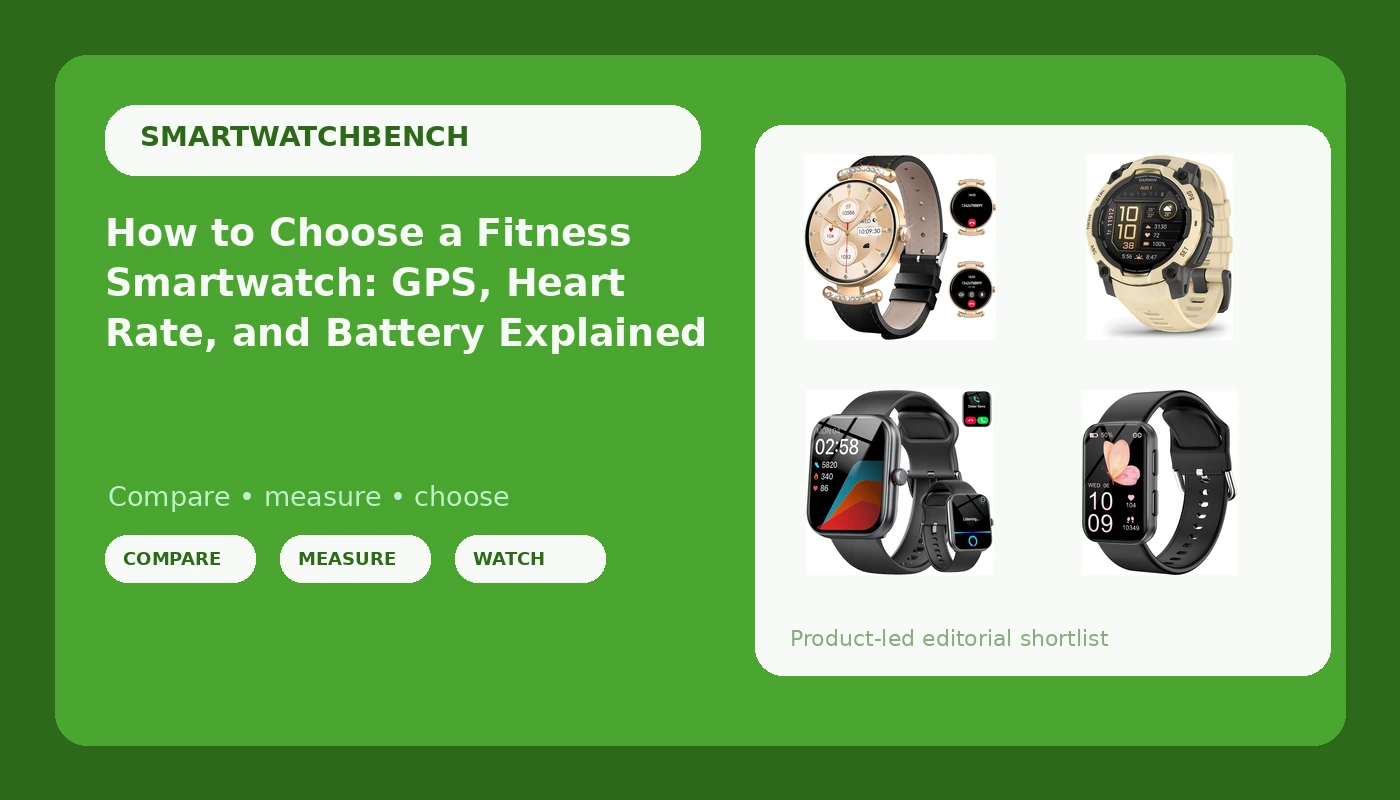
Choosing a fitness smartwatch is really three questions wearing a trench coat. Does the watch record its own GPS, or does it borrow the phone in your pocket? Can you verify the heart rate number it shows you? And how many days does the battery last when notifications and workouts are both switched on? Everything else, screen size, band color, voice assistant, is preference. Those three are the difference between a training tool and a wrist accessory. This guide walks through four very different wearables, from a light everyday tracker to a rugged outdoor GPS watch, and explains what each one is actually built to do.
Related: Garmin vs Apple Watch for Runners: What a GPS Trace Actually Shows →
Quick answer
Match the watch to the job. If you run, hike, or ride outdoors and want the watch itself to record the route, the Garmin Instinct 3 is the outdoor option in this group. If you want a large screen, a built-in voice assistant, and calling from the wrist on either iPhone or Android, the Alexa built-in watch fits that role. If you want an AMOLED display and Bluetooth calling at the lowest entry point here, the women's AMOLED model covers it. If you mostly want steps, sleep, and heart rate in a light band with a spare strap, the MorePro tracker is that. None of these four is a clinical device, and none of the numbers they display should be treated as medical measurements.
Four useful options
| Model | Best fit | What stands out |
|---|---|---|
| Garmin Instinct® 3-45 mm, AMOLED Display, Rugged Outdoor GPS Smartwatch, Built-in Flashlight, Alpine Rush Collection Limited Edition Color, Citrine with Citrine Band | Trail, hiking, and outdoor days where you want navigation on the wrist | Rugged 45 mm case, AMOLED display, built-in flashlight, and onboard GPS in the listing |
| Smart Watch for Women Men, Alexa Built-in, Smartwatch for iPhone & Android Bluetooth Call, 1.91" HD Fitness Tracker with Heart Rate/SpO2/Sleep Monitor, IP68 Waterproof, Fitness Watch 100+ Sports Modes | A large screen, voice control, and calling on either phone platform | 1.91 inch HD display, Alexa built in, IP68 rating, heart rate, SpO2, and sleep tracking |
| Smart Watches for Women,Answer/Make Call,1.32" AMOLED Ultra-Clear Screen Smartwatch with Heart Rate,Sleep Monitor, Watches for Women for Samsung/Android/iOS,100+ Sports Mode,3ATM Waterproof | A first smartwatch with an AMOLED screen and calling | AMOLED display, answer and make calls, heart rate and sleep monitoring, 3ATM water resistance |
| MorePro Fitness Tracker for Women Men, Heart Rate, Blood Pressure, 2 Bands | Light everyday tracking and step counting | Heart rate tracking, a blood pressure readout, and two bands in the box |
Best for outdoor and trail use: Garmin Instinct® 3-45 mm, AMOLED Display, Rugged Outdoor GPS Smartwatch, Built-in Flashlight, Alpine Rush Collection Limited Edition Color, Citrine with Citrine Band
The important part is not the colorway. It is that the watch records position itself, so a route gets captured even when the phone stays home or dies halfway through a long run. Verify two things on the product page before buying: what the battery rating refers to (GPS-on and smartwatch mode are wildly different numbers, and outdoor spec sheets rarely lead with the one you care about), and which navigation and routing features are included versus sold separately through an app. A flashlight sounds like a gimmick until you are finishing a trail run at dusk.
Best for a large screen and voice control: Smart Watch for Women Men, Alexa Built-in, Smartwatch for iPhone & Android Bluetooth Call, 1.91" HD Fitness Tracker with Heart Rate/SpO2/Sleep Monitor, IP68 Waterproof, Fitness Watch 100+ Sports Modes
The trade-off is what you get for the screen size. A 1.91 inch display is comfortable for reading notifications and glancing at a workout summary, but it also means a physically larger watch on a small wrist. And this class of watch is a phone companion, not an independent navigator: the listing does not describe onboard GPS, so distance and pace depend on the phone being with you. SpO2 readings here are spot checks, useful for spotting trends, not for diagnosing anything. If you want a big, bright screen and voice control, this is the fit. If you want to leave the phone behind, it is not.
Best for a first smartwatch: Smart Watches for Women,Answer/Make Call,1.32" AMOLED Ultra-Clear Screen Smartwatch with Heart Rate,Sleep Monitor, Watches for Women for Samsung/Android/iOS,100+ Sports Mode,3ATM Waterproof
Read the water rating carefully, because 3ATM does not mean swim-proof. A 3ATM rating is tested against static pressure and is generally treated as protection from rain, splashes, and hand washing, not from laps in a pool. The 1.32 inch AMOLED panel is the real selling point at this level, since AMOLED delivers deeper blacks and better contrast than the LCD panels common on budget watches. The 100+ sport modes listed are mostly preset labels for organizing workouts rather than distinct sensor behaviors, so treat them as convenience, not capability. As with the Alexa model, there is no onboard GPS in the listing, so runs are phone-tracked.
Best for light everyday tracking: MorePro Fitness Tracker for Women Men, Heart Rate, Blood Pressure, 2 Bands
Be skeptical of the blood pressure feature specifically. Wrist-based blood pressure from a consumer band is not a clinical measurement, and it should never replace a cuff. If blood pressure is your reason for buying, buy a cuff. What this tracker is genuinely good at is the boring stuff: steps, sleep duration, resting heart rate trends, and being light enough that you forget it is on. That is a legitimate use case, and for a lot of people it is the whole use case.
Prices and availability may change. Product images, names, and retailer links are matched to verified listings. No current price, rating, stock status, or measured result is stated here without current evidence.
What the sensors can and cannot tell you
Optical heart rate on the wrist works by shining light into the skin and watching how blood flow changes the reflection. It is fine at steady state. It struggles exactly where athletes care most: intervals, hill repeats, and anything where your heart rate changes fast. There is a physical lag between what your heart does and what the sensor sees, and arm motion adds noise on top of it. That is why a chest strap remains the reference. If a watch reading jumps 30 beats in two seconds during a hard effort, that is the sensor catching up, not your body.
SpO2 is a spot measurement in most wearables. A single number taken while you sit still tells you very little on its own. Trends over weeks are more meaningful than any one reading. Wrist blood pressure is further out still: consumer bands are not validated clinical devices, and the reading should be treated as a curiosity rather than a health metric.
GPS has its own set of failure modes. A watch that samples position infrequently will cut corners on tight switchbacks and report a shorter distance than you actually ran. A watch that samples often burns battery faster. Trees, tall buildings, and canyon walls all degrade the signal. The only way to know how a specific watch behaves on your routes is to compare its trace against a course you already know the length of, ideally more than once.
How to read a spec sheet before you buy
Two watches can list identical features and behave completely differently. The spec sheet is a starting point, not an answer. Here is what to check.
- Find out whether GPS is onboard or connected. "Connected GPS" means the watch uses your phone's location, which is fine if you always carry the phone and useless if you do not.
- Check what the battery number refers to. A multi-day claim usually means smartwatch mode with notifications, and GPS use can cut it down sharply. Look for the GPS-on figure separately.
- Read the water rating literally. IP68 covers dust and water immersion under defined test conditions, while 3ATM is generally splash and rain protection. Neither automatically means swim-proof.
- Note the display type. AMOLED gives better contrast and usually worse always-on battery drain than LCD. Decide which of those you care about before you fall for a bright demo screen.
- Check what needs a subscription or an app account. Some navigation, map, and advanced metric features live behind a paywall that is not mentioned in the headline specs.
What to check in the first two weeks
- Wear it overnight at least once to see whether the sleep tracking and the comfort hold up.
- Do a familiar route and compare the distance against what you know it to be.
- Wear a chest strap for one interval session and compare the traces afterward.
- Turn notifications on for a full day and watch how fast the battery drops.
- Test the water resistance claim only as far as the rating allows, and not further.
Which option should you choose?
Choose the Garmin Instinct® 3 when you run, hike, or ride outdoors and want the watch to record the route without a phone, plus a flashlight and a rugged case for rough conditions. Choose the Smart Watch for Women Men, Alexa Built-in model when a large screen, voice control, and Bluetooth calling matter more to you than onboard GPS. Choose the Smart Watches for Women AMOLED model when you want calling and an AMOLED panel at the lowest entry point in this group. Choose the MorePro Fitness Tracker when you want a light band for steps, sleep, and heart rate, and you are comfortable ignoring the blood pressure readout.
The caveat that applies to all four: this article describes what each listing says, not measured performance. Nobody should buy a watch based on a spec sheet alone, including this one. Confirm the current details on the product page, and if a metric matters to your training, plan to verify it yourself with a known course or a chest strap.
The bottom line
Buy the sensor set that matches your sport, not the biggest feature list. Onboard GPS is the line that separates a training watch from a phone accessory, and the Instinct 3 is the one here that crosses it. The Alexa model and the AMOLED model are phone companions with good screens and calling, which is exactly what a lot of people want. The MorePro tracker is a light everyday band, and the blood pressure feature on it is best treated as decoration. Pick the role first, then the watch, and verify the battery and GPS claims on the listing before you commit.