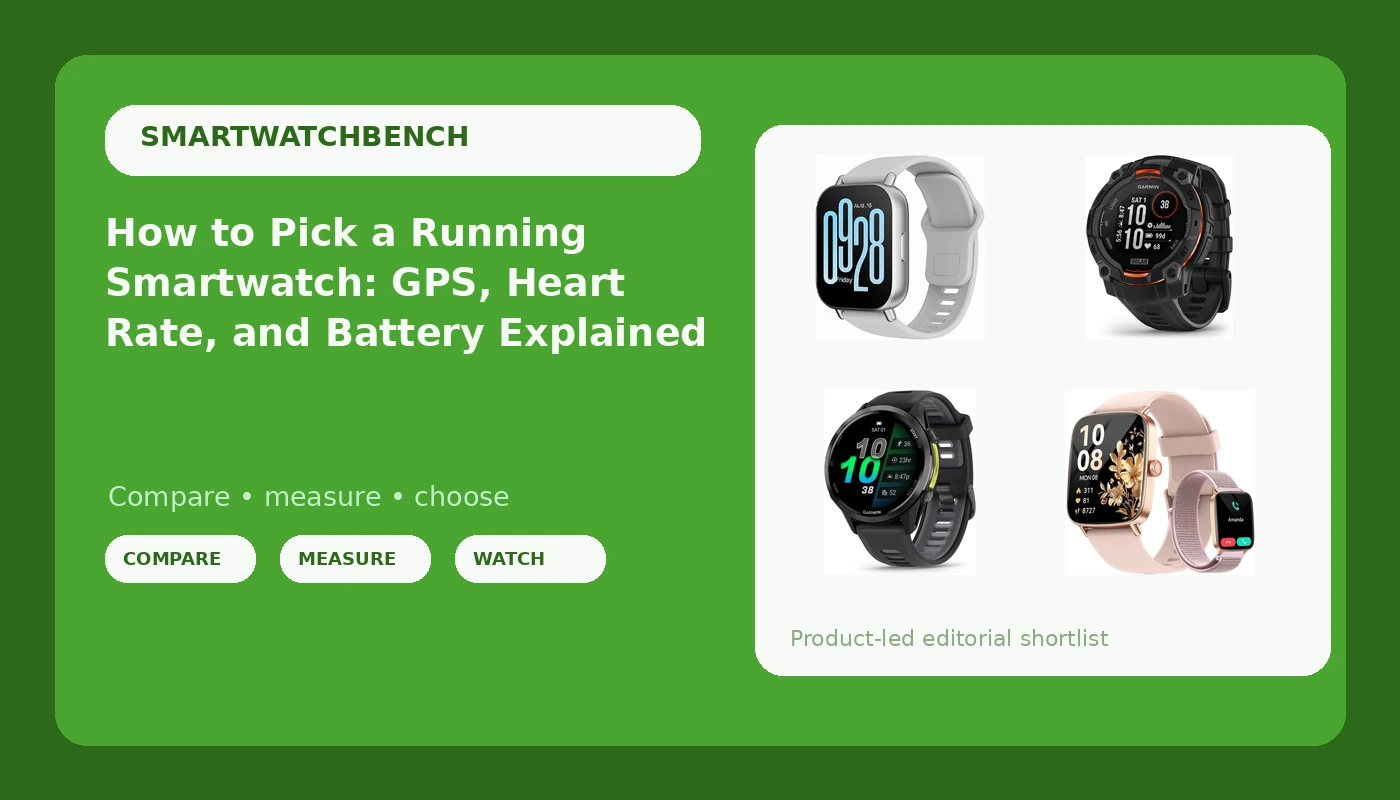
Buying a running smartwatch is mostly an exercise in ignoring the box copy. Every watch promises accurate GPS, dependable all-day heart rate, and battery life measured in weeks, then measures all three differently. The question that actually decides your purchase is not which running smartwatch has the longest spec sheet, it is which one matches the way you train. The four models below sit at four different points on that map, from a budget tracker to a titanium training watch, and the cheaper ones are not simply watered-down versions of the expensive ones. They are built for different jobs.
Related: Why GPS Accuracy Is the Only Metric That Matters →
Quick answer
Match the watch to the work. If you train by pace and race with a plan, you want a dedicated GPS training watch, and the Garmin Forerunner 970 is the one in this group built for exactly that. If you are hard on gear or spend days away from an outlet, the rugged Garmin Instinct 3 Solar is the more sensible shape of watch. If you run a few times a week and mostly want notifications, calls, and step counts, the XIAOMI Redmi Watch 5 Active covers it for a fraction of the money. And if a watch is jewelry first and a tracker second, the 1.85 inch smart watch that ships with two bands is the honest answer. None of the four is universally better than the others, because each one wins on a different criterion.
Four useful options
| Model | Best fit | What stands out |
|---|---|---|
| Garmin Forerunner® 970, 47mm | Racing and structured training | Carbon Gray DLC titanium finish in a 47mm Forerunner case |
| Garmin Instinct® 3 Solar, 45mm | Rugged daily wear and days off-grid | Solar charging and a rugged 45mm case |
| XIAOMI Redmi Watch 5 Active | Budget daily tracking and calls | 2.0 inch LCD, rated 18 days of battery life, 140+ sport modes, 5ATM water resistance |
| Smart Watch for Women, 1.85" | Everyday wear, calls, and outfit changes | Two bands included and call answering on the wrist |
The training pick: Garmin Forerunner® 970, 47mm, Carbon Gray DLC Titanium, Black/Whitestone
The trade-off is the one every premium training watch carries: you are buying the sensor package, the training software, and the build quality together, and you cannot opt out of the parts you will not use. If your week is two easy runs and a walk with the dog, most of what makes this watch interesting stays dormant. It is also a 47mm case, which is a lot of watch on a smaller wrist, and a titanium finish invites you to treat it as a daily wearer when it really wants to be a tool.
The rugged pick: Garmin Instinct® 3 Solar, Rugged GPS Smartwatch, 45mm, Black
Solar charging changes how you think about a watch. Instead of a weekly ritual you stop noticing, you get a passive trickle that rewards being outside, which is the whole point for anyone training outdoors. The cost is visual: rugged cases are chunky, they read as outdoor equipment, and they will not pass for a dress watch at a wedding. If your watch is a single do-everything object rather than one piece of a rotation, that bulk is the price of admission.
The budget pick: XIAOMI Redmi Watch 5 Active Smartwatch, 2.0" LCD Display
Be honest about the job this watch does. A tracker at this level is best thought of as a step counter, a sleep logger, a notification screen, and a phone extension on your wrist, with workout modes on top. That is genuinely useful, and it is a lot of device for the category. What it is not is a replacement for a dedicated GPS training watch if you care about pace on a measured course, because that kind of precision is where the money in the expensive tier gets spent. Buy it for the daily experience and you will be happy, buy it for interval splits and you will be disappointed.
The everyday pick: Smart Watch for Women, 1.85" HD Smartwatch (Answer/Make Calls), 2 Bands
The two-band bundle is the detail worth noticing, because band swapping is the cheapest way to make one watch work with a workout outfit and an office outfit. The limitation is the same one every lifestyle-first smartwatch carries: the sensor story is secondary to the display, the call handling, and the look. If your definition of training is walks and the occasional gym session, that trade is fine. If you are chasing a marathon personal best, this is not the instrument for it, and pretending otherwise wastes your money.
Prices and availability may change. Product images, names, and retailer links must be matched by verified ASIN. Do not state a current price, rating, stock status, or measured result without current evidence.
What GPS accuracy actually means
GPS accuracy is not a single number on a spec sheet. It is the difference between the line a watch draws and the line you actually ran. Two watches can both claim GPS and produce distance totals that differ by a meaningful margin on the same route, because they handle the hard parts differently: tight corners, switchbacks, tree cover, and the urban canyon between tall buildings where satellite signals bounce.
The corner problem is the one that matters most to runners. When a watch samples your position less often, it connects the dots with straight lines and cuts the inside of every bend. On an out-and-back with a lot of turns, that can shave real distance off your total, which means your watch reports a faster pace than you ran. On a certified course, that error is visible the moment you compare the watch's distance to the course's measured distance.
You cannot verify any of this from the watch face. The only honest test is a known distance: a measured loop, a certified race course, or a second device carried alongside. Fifteen minutes of that comparison tells you more than a page of marketing. If a watch's trace cuts corners on a trail with switchbacks, you will feel it in your splits before you see it in the numbers.
Wrist heart rate versus a chest strap
Optical wrist heart rate is convenient and it is not a chest strap. The sensor shines light into your skin and reads the pulsing of blood, which works well when you are sitting still and works less well when your arm is swinging, your wrist is cold, or the strap is loose enough to let light leak in.
The classic failure shows up at the start of an interval. You accelerate, your actual heart rate climbs quickly, and the wrist sensor lags behind, sometimes spiking oddly and then settling. That lag is why athletes who train by heart rate zones often wear a chest strap for quality sessions and use the wrist sensor for easy days.
You can sanity check a wrist reading without any equipment. Compare the number to how you feel using the talk test, count your pulse manually for fifteen seconds at a stoplight, and notice whether the reading tracks your effort or jumps around randomly. If a watch consistently disagrees with your body, trust your body until you have evidence otherwise.
- Write down the workouts you actually did over the past month, not the ones you plan to do.
- Decide whether you need distance and pace you can verify, or whether presence and step tracking is enough.
- Check case size against your wrist: a 47mm training watch and a slim band watch wear very differently.
- Decide how you want to charge: solar trickle, a weekly cable, or a nightly routine.
- Confirm the features you would genuinely use, including call handling and a 5ATM water resistance rating if you swim.
What to check before you buy
- Case size and weight, especially if you wear the watch to sleep.
- Charging style, because solar charging and a proprietary cable demand different habits.
- Water resistance ratings, if pool or open water swimming is part of your week.
- Whether on-wrist call answering matters, since it is a headline feature on some models and absent on others.
- Band options, because two bands in the box saves you a purchase later.
- A plan to verify the watch in the first two weeks, using a known course rather than the watch's own summary.
Which option should you choose?
Choose the Garmin Forerunner® 970, 47mm when you race, follow a structured plan, and want a training instrument with a titanium build. Choose the Garmin Instinct® 3 Solar, 45mm when durability and solar charging matter more to you than a slim profile. Choose the XIAOMI Redmi Watch 5 Active when you want calls, notifications, workout modes, and a long rated battery life without spending training-watch money. Choose the Smart Watch for Women, 1.85" HD Smartwatch when the watch needs to look right with everything you wear and calls are the feature you use most.
A caveat worth stating plainly: none of the durability, accuracy, or battery claims above are things I can confirm from a product listing. The rated figures come from the manufacturer, and the honest way to judge them is to test one against your own routes. I will not call a watch accurate, tough, or long-lasting without that comparison, and neither should a spec sheet.
The bottom line
The right running smartwatch is the one whose strengths line up with the workouts you actually do. A titanium Forerunner makes sense if you train with purpose and want the build to match. A rugged solar watch makes sense if your watch takes hits and you would rather not think about charging. A budget tracker makes sense if calls and notifications are the point and running is a hobby. A slim two-band smartwatch makes sense if the watch is part of your outfit. Pick the criterion that describes your week, and the choice stops being difficult.