Related: How to Test a Running Watch Before You Trust It
I have worn a watch on every run, ride, and race since 2019, and after more than 8,000 logged miles the only thing I still care about is whether the numbers are true. Distance, pace, heart rate, battery. Everything else is a notification machine with a strap. That is the lens I bring to this guide to the best smartwatches for runners, and it is why the four watches below sit in four very different places in my head.
The short version: the Apple Watch Series 11 is the best all-rounder in this group, the Apple Watch SE 3 is the value play for iPhone owners, the Samsung Galaxy Fit 3 is the battery champion of the budget tier, and the call-capable smart watch for women is a phone accessory that happens to count steps. Two of these are serious training tools. One is a genuinely useful band. One is jewelry with a heart rate guess, and I will tell you exactly which is which.
None of them is a dedicated running computer from one of the endurance brands, and I say that as someone who tells runners to buy a Forerunner before they buy anything else. But not everyone wants a plastic training tool on their wrist. If you want one watch that handles your training and your texts, this is the shortlist.
Best Overall: Apple Watch Series 11
The Series 11 is the watch I recommend to people who want one device and refuse to think about it again. The 42mm jet black aluminum case with the black sport band is the configuration I would pick, and it is light enough that you stop noticing it by the second mile. The always-on display means you can glance at pace without lifting your wrist, which sounds like a small thing until you are doing 800 meter repeats in the dark.
The health side is where Apple has pulled ahead of everyone else. Sleep score, fitness tracking, and the broader health monitoring suite are all here, and they are the features people actually use after the novelty of watch faces wears off. Water resistance means you can wear it through rain, sweat, and the post-run shower.
The catch is the one every Apple owner knows. Battery life is a daily chore. Apple does not publish a number in this listing that survives a marathon weekend, and the honest guidance is to charge it every night and plan a top-up before long runs. If you are the kind of person who forgets to charge things, this is the watch that will teach you a lesson.
Best Value: Apple Watch SE 3
The SE 3 is the watch I would put on most runners' wrists. It keeps the pieces that matter for training, the fitness and sleep trackers, the heart rate monitor, the always-on display, and the water resistance, and it drops the extras that mostly matter to people who read spec sheets for fun. The 40mm starlight aluminum case is the cleaner look of the two Apple options, and the sport band is the same comfortable band as the flagship.
What you give up is the health sensor suite and the premium materials. What you keep is the part of the experience you use every day. If you have ever looked at your watch mid-run, you know the always-on display is doing more work for you than any sensor you cannot name.
The battery situation is the same as the flagship: plan on charging it nightly. That is the Apple tax, and the SE 3 does not escape it. What it does escape is the flagship premium, which makes it the smarter buy for anyone whose training is running rather than triathlon.
Best Budget: Samsung Galaxy Fit 3
This is the battery champion of the group. The listing claims 14 days, and even if you assume that number was written with light use in mind, a band this size with a 1.6 inch AMOLED display is a different category of convenience from a watch you charge every night. The screen is bright and readable in daylight, which is the thing cheap bands usually get wrong.
IP68 water resistance means rain, sweat, and showers are not a problem. The 100+ watch faces and 100+ exercise modes are the sort of numbers that look better on a product page than in daily life, but the exercise mode list is genuinely broad, and the fast charger bundle in the box is a nice touch.
Here is my honest read on bands like this one. A band is not a chest strap, and wrist heart rate on a band struggles most exactly when you care most, during intervals, when your wrist is moving and your heart rate is changing fast. The distance and pace are approximations. That does not make it useless. It makes it a great sleep tracker, a great step counter, and a solid everyday band for someone on Android who wants two weeks between charges. It is not the thing I would build a marathon block on.
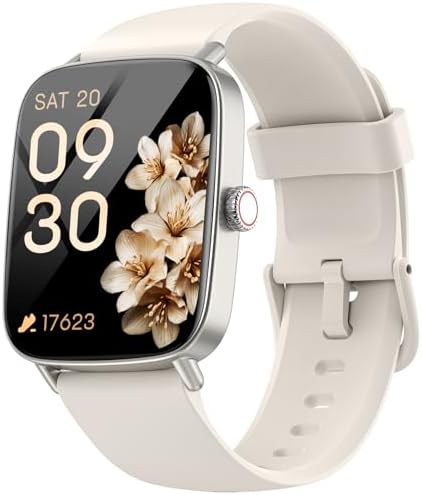
Cheapest: Smart Watch for Women with Call Support
Let me be fair to this one, because it does the job it was designed for. The 1.85 inch HD screen is the biggest in this group and the easiest to read. It answers and makes calls, which is the feature most people actually buy a cheap smart watch for, and it ships with two bands so you can change the look without buying anything else.
What it is not is a training tool. There is no water resistance rating listed, so I would not swim or shower in it. The step count is a step count, and the heart rate is a guess dressed up as a number. If you have ever watched a cheap band spike to 180 while you are standing at a crosswalk, you know the drill. Cheap fitness bands are step counters with a heart rate guess, and that is not a knock on this watch specifically, it is the category.
Buy it if you want calls on your wrist, notifications you can glance at, and a big bright screen for a very low entry point. Do not buy it expecting training data you can trust.
How I test, and how to read these specs
Every watch on this bench goes through the same four checks, and they are the four checks you should run yourself in the first two weeks with anything you buy.
The GPS check: run a route you know the distance of, ideally a certified course, and compare. A watch that is off by 100 meters over a 5K is a watch that is lying to you, and no amount of software polish fixes a bad antenna.
The heart rate check: wear a chest strap on the same run and compare the traces afterward, especially during intervals. Wrist heart rate lags on every watch ever made, but the good ones catch up within a few seconds. The bad ones spike randomly and never recover.
The battery audit: ignore the light-use number on the box and log real days. GPS on, notifications on, always-on display on if the watch has one. That is the only battery number that matters.
The software check: does it sync without drama, does the app make sense, and does an update break a feature you relied on. The software is the watch. A great sensor with buggy software is a great sensor you cannot trust.
Analysis: what actually matters on the run
The gap between the flagship and the budget tier is smaller than the price tags suggest for one simple reason. Most of what you pay for at the top is health monitoring, materials, and ecosystem, not running accuracy. If your sport is running, the questions are narrow. Does the GPS trace match the course. Does the heart rate match the strap. Does the battery survive the week.
The Apple Watch Series 11 and the SE 3 answer those questions well and add the best health and sleep features in this group. The trade is the nightly charge, which is the single most common complaint I hear from Apple owners who run long distances. The Galaxy Fit 3 answers the battery question best and the accuracy questions adequately for casual training, which is exactly what a band is for. The call-capable smart watch answers a different question entirely, and it answers it well, as long as you are honest about which question you are asking.
One more thing about specs. Display size is not a training feature, water resistance is, and "100+ exercise modes" is a marketing number. The only two lines on a product page that predict whether you will still be wearing the watch in six months are the battery claim and the sensor list.
Smartwatch comparison table
| Watch | Display | Battery claim | Water resistance | Best for | Price |
|---|---|---|---|---|---|
![Apple Watch Series 11 [GPS 42mm] Smartwatch with Jet Black Aluminum Case with Black Sport Band - S/M. Sleep Score, Fitness Tracker, Health Monitoring, Always-On Display, Water Resistant](/images/products/B0FQFL8PZ5.jpg) Visit on Amazon → Visit on Amazon →Apple Watch Series 11 (GPS 42mm) |
42mm, always-on | Not stated in the listing | Water resistant | All-round training, health, and sleep | Check current Amazon price |
![Apple Watch SE 3 [GPS 40mm] Smartwatch with Starlight Aluminum Case with Starlight Sport Band - S/M. Fitness and Sleep Trackers, Heart Rate Monitor, Always-On Display, Water Resistant](/images/products/B0FQFNRH72.jpg) Visit on Amazon → Visit on Amazon →Apple Watch SE 3 (GPS 40mm) |
40mm, always-on | Not stated in the listing | Water resistant | iPhone owners who want the core features | $239.00 |
![SAMSUNG Galaxy FIT 3 [2025, 40MM] 1.6 inch AMOLED Display, IP68 Water Resistant, 14 Days Battery Life, 100+ Watchfaces, 100+ Exercise Modes, International Model (Fast Charger Bundle, Black)](/images/products/B0CTCLBST5.jpg) Visit on Amazon → Visit on Amazon →SAMSUNG Galaxy Fit 3 |
1.6 inch AMOLED | 14 days claimed | IP68 | Battery life, sleep, everyday wear | $43.00 |
 Visit on Amazon → Visit on Amazon →Smart Watch for Women |
1.85 inch HD | Not stated in the listing | Not stated in the listing | Calls and notifications on a budget | $43.16 |
The table tells the story quickly. Two watches with real health hardware and a nightly charge. One band with a two-week battery claim and casual-grade accuracy. One big screen that makes calls. Match the row to your actual habit, not to the row you wish described you.
Should you buy the Apple Watch Series 11?
Yes, if you want the best all-rounder and you accept charging it daily. The sleep score, the health monitoring, and the always-on display are the strongest combination in this group, and the 42mm aluminum case is comfortable enough for long runs. It is the watch I would hand to someone who wants one device for training and for life, and it is the one I would keep on my own wrist.
The compromise is real and it is the same every year. You charge it at night, which means you either sleep with it on a charger you have to think about or you give up sleep tracking. Work that out before you buy, not after.
Should you buy the Apple Watch SE 3?
Yes, for most iPhone owners. You keep the always-on display, the fitness and sleep trackers, the heart rate monitor, and the water resistance, and you skip the flagship premium. The 40mm starlight case with the matching sport band is the cleanest looking watch here.
If you have the budget and you care about the extra health features, the Series 11 is the better watch. If you care about running, sleeping, and getting your texts, the SE 3 is the smarter purchase.
Should you buy the Samsung Galaxy Fit 3?
Yes, if battery life is your top priority and you are on Android. Fourteen days between charges changes how you live with a wearable, and the 1.6 inch AMOLED panel and IP68 rating cover the daily basics well. The fast charger bundle and the broad exercise mode list round it out.
Just do not expect chest strap accuracy during intervals. A band is a band, and the wrist heart rate is the first thing to suffer when the pace changes.
Should you buy the Smart Watch for Women?
Only if calls and notifications are the point. It makes and answers calls, the 1.85 inch HD screen is the biggest and brightest here, and two bands in the box is a genuinely nice touch at this end of the market.
If you want training data you can trust, save up and go with one of the Apple watches or the Galaxy Fit 3. If you want your wrist to buzz when your phone rings and you want to see the message without digging the phone out of your pocket, this one does that job.