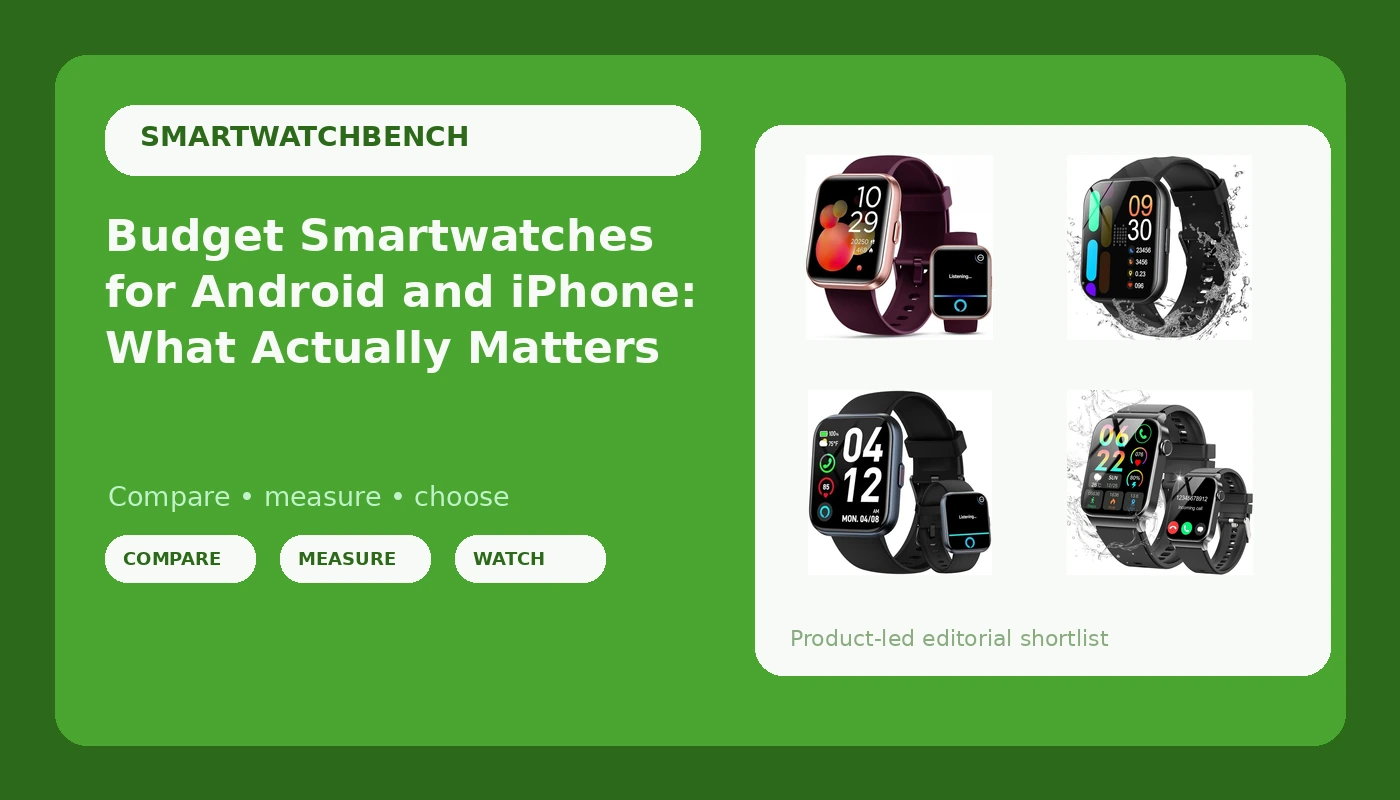
A budget smartwatch for Android and iPhone is one of the few categories where four listings can look nearly identical and still suit completely different people. Every watch in this guide promises Bluetooth calling, wrist heart rate and sleep tracking, a long list of sport modes, and some form of water resistance. Read the names closely and the differences surface: a 1.85-inch screen versus a 1.8-inch screen, IP68 versus 5ATM, Alexa built in versus not listed, and SpO2 appearing on one spec sheet but not the others.
That is the real problem with this price band. The feature lists are long, the language is loose, and the details that decide whether you keep wearing the watch are buried three lines down. This guide walks through what each of these four models is built around, what the water and sensor ratings actually mean, and how to match a watch to the way you actually move.
Related: Why Wrist Heart Rate Lags a Chest Strap →
Quick answer
All four watches here cover the same basics: Bluetooth calling, wrist-based heart rate and sleep tracking, and a sport mode list of 110 or more. What separates them is the water rating class, the display size, whether Alexa is listed as built in, and whether SpO2 appears on the spec sheet. If you swim, the Parsonver and its 5ATM rating is the one to look at first. If you want a voice assistant on your wrist, the two Alexa models are the ones to compare. If screen space is your priority, the STECEi at 1.85 inches has the largest display of the group.
Four useful options
| Model | Best fit | What stands out |
|---|---|---|
| STECEi Smart Watch for Men Women Bluetooth Call | Everyday wear with the largest display | 1.85-inch HD screen, Bluetooth calling, 110+ sport modes, IP68 |
| Parsonver Smart Watch | Swimming and water sports | 5ATM water resistance rating, 110+ sport modes |
| Smart Watches for Men Android & iPhone, 1.8" HD Alexa Built-in | Voice assistant and SpO2 on the spec sheet | Alexa built in, heart rate, sleep and SpO2 monitoring, IP68 |
| Smart Watches for Women with Alexa | Smaller, design-led wear with Alexa | Alexa, call and notification alerts, 1.8-inch display, dark purple colorway |
Everyday pick with the biggest display: STECEi Smart Watch for Men Women Bluetooth Call, 1.85" HD Screen Smartwatch with Heart Rate/Sleep Monitor, 110+ Sport Modes Activity Trackers IP68 Waterproof, Fitness Watch for Android iOS, Black
Screen size is the most visible trade-off in this group, and it cuts both ways. A 1.85-inch panel fits more of a notification on screen and makes the watch easier to read at a glance mid-run, but a bigger case sits heavier on a smaller wrist and can catch on a jacket sleeve. If you have never worn a watch this size, measure your wrist and compare it against the case dimensions before you commit. Note also that IP68 is an ingress protection rating, not a depth rating, which is a distinction worth understanding before you take it in a pool.
The swimming option: Parsonver Smart Watch, 5ATM Waterproof Watch for Swimming, 110+ Sport Modes
Here is the part most buyers skip. ATM stands for atmospheres, and 5ATM is a static pressure rating that manufacturers commonly equate to roughly 50 meters of still water depth. IP68 is a different standard entirely: the "6" covers dust and the "8" covers continuous immersion, with the exact conditions defined by the manufacturer rather than by a fixed depth. Neither rating promises protection from high-speed water impact, hot showers, or steam. If your training happens in a pool, the 5ATM claim on the Parsonver is the more directly relevant one.
The Alexa and SpO2 option: Smart Watches for Men Android & iPhone, 1.8" HD Alexa Built-in Smartwatches Fitness Tracker Watch with Bluetooth Calls, IP68 Waterproof, Heart Rate/Sleep/SpO2 Monitor, 110 Sport Modes - Black
Two caveats apply to both headline features. First, a built-in assistant is only useful if you actually talk to your wrist; most people try it for a week and go back to their phone. Second, SpO2 on a wrist wearable is a spot estimate, not a medical measurement, and it is sensitive to fit, motion, and skin perfusion. Treat a single reading as a curiosity and a consistent overnight trend as the more interesting signal. If neither feature changes your day, you are paying for spec-sheet depth rather than function.
The women's design option: Smart Watches for Women, Smart Watch for Android Phones & iPhone, Fitness Watches for Women with Alexa, Call & Notification Alerts, Tracks Heart Rate/Sleep Smartwatches (Dark Purlple, 1.8 inches)
Notice what is missing from the listing relative to the other two: there is no SpO2 mention and no water resistance class stated in the product name. That does not mean the watch cannot handle a splash, but it does mean you should not assume a swimming rating that was never claimed. If you want the smaller, more design-forward case and you train on land, this is a reasonable fit. If you want to swim with it, the Parsonver is the safer conversation to have with yourself.
Prices and availability may change. Product images, names, and retailer links are matched to verified listings. No current price, rating, stock status, or measured result is stated here without current evidence.
What IP68 and 5ATM actually mean
These two labels get used interchangeably in marketing copy, and they should not be. IP68 comes from the ingress protection standard: the first digit rates solids (6 is the top dust rating) and the second rates liquids (8 means protection against continuous immersion, with the depth and duration specified by the manufacturer rather than fixed by the standard). A watch can carry IP68 and still not be rated for swimming, because the manufacturer defines the test conditions.
5ATM is a pressure rating. One atmosphere is roughly the pressure of 10 meters of still water, so 5ATM is commonly described as equivalent to about 50 meters of static depth. That sounds like a dive rating and is not one. Both ratings assume still, room-temperature water. Neither covers the impact pressure of a dive entry, the heat of a shower, or steam in a sauna, and those are the three most common ways people kill a watch that was rated for water in the first place.
The practical takeaway: if water is part of your training, look for an explicit ATM figure. If water is only an occasional splash risk, an IP68 claim is usually enough, as long as you accept that the manufacturer defines what it tested.
Reading a spec sheet without getting fooled
Budget wearables share a vocabulary that makes them sound more capable than they are, and the fastest way to buy well is to know which numbers carry weight.
Sport mode counts are the clearest example. "110+ sport modes" is a preset list, and the number says nothing about how well any single mode tracks. The modes that matter are the two or three you will actually use, and the sensor set underneath them is what determines whether the data is useful.
Display claims are similar. "HD" without a stated resolution is a marketing adjective, not a measurement. Screen size in inches is the more reliable figure because it tells you something about how the watch will feel on your wrist and how much of a notification you will read before you have to stop and look properly.
Heart rate deserves the most skepticism. Every watch in this group uses wrist-based optical sensing, which is convenient and also the least accurate way to measure heart rate during hard, short intervals. A chest strap remains the reference standard. Wrist optical heart rate tends to track well at steady effort and lag or spike when your arm is moving and your heart rate is changing fast. If your training depends on interval accuracy, no watch in this price band replaces a strap, and no spec sheet changes that.
Battery figures are the other number to treat carefully. Manufacturers typically quote life at light use, with notifications off and GPS idle. Your real number will be lower, and the honest way to compare is to read how each listing defines its own test conditions rather than to compare headline figures across brands.
A five-step way to decide
- Write down the single thing you need the watch to do. Calls, sleep, swimming, or Alexa. One thing.
- Decide whether water is part of your training, then filter by rating class, not by the word "waterproof."
- Check whether the features you care about appear in the product name or description, since an unstated feature is an unverified one.
- Match the display size to your wrist and to how you read notifications, not to the biggest number available.
- Accept that wrist heart rate is a trend tool at this price, and budget for a chest strap if accuracy during intervals matters to you.
Matching a watch to your routine
- If you swim, treat the 5ATM Parsonver as the starting point and read the other listings as land watches.
- If you want a voice assistant, compare the two Alexa models directly and ignore the rest of the field.
- If you read long messages on your wrist, the 1.85-inch STECEi display is the one that gives you the most room.
- If you have a smaller wrist, remember that a 1.8-inch case is still a large watch, and check the dimensions before ordering.
- If you care about blood oxygen readings, understand that a wrist SpO2 number is a spot estimate and that fit and motion change it more than anything else.
Which option should you choose?
Choose the STECEi Smart Watch for Men Women Bluetooth Call when you want the largest display in the group and Bluetooth calling as the centerpiece. Choose the Parsonver Smart Watch when swimming or water training is part of your week and you want an explicit 5ATM rating. Choose the Smart Watches for Men Android & iPhone, 1.8" HD Alexa Built-in when Alexa and SpO2 both need to appear on the spec sheet. Choose the Smart Watches for Women with Alexa when you want the assistant and alert features in a design-led, dark purple package and you train on land.
One limitation applies across all four. Nothing here is a GPS accuracy instrument, and nothing here replaces a chest strap for interval work. These are notification-and-trend devices that happen to track workouts. That is a legitimate job, and it is the job you are actually buying.
The bottom line
The four watches in this guide share a common floor: Bluetooth calling, wrist heart rate and sleep tracking, and a long preset list of sport modes. What you are really choosing between is a bigger screen, a pressure-based water rating, a built-in voice assistant, and a design direction. Pick the one whose single distinguishing feature matches the single thing you need, and read the water rating class carefully before you get in a pool. Everything else on these spec sheets is a list of features you will use twice and forget.