I plugged my watch in while I showered this morning, same as I do every day, and it hit 100% before I finished drying off. That's the ritual now. But the question I keep getting from readers isn't about battery life or step counts. It's about GPS. Specifically: is my cheap watch's GPS as good as the GPS on my phone? And honestly, it depends on which lie you'd rather believe.
Related: How To Improve Smartwatch Gps Accuracy
The short answer: a dedicated GPS watch is more accurate than a phone for tracking runs, but not by the margin you'd expect, and the gap shrinks even further when you're on a well-marked road course. I ran my known 5-mile loop three times last week with three different devices strapped to my body. The results surprised me.
What GPS watches do better:
- Lock onto satellites faster and hold the signal through tree cover
- Track your pace in real time without carrying a 6-inch slab in your hand
- Give you a consistent data set across months of training, not just when you remember to open the app
What phones do better:
- Cost nothing extra if you already own one
- Use cellular assist to get a quick lock in urban canyons
- Have bigger screens for live maps mid-run
What both do badly:
- Lie about distance in the same places. That one bridge on Maple Street? Both my phone and my watch add an extra tenth of a mile every single time.
Compared to
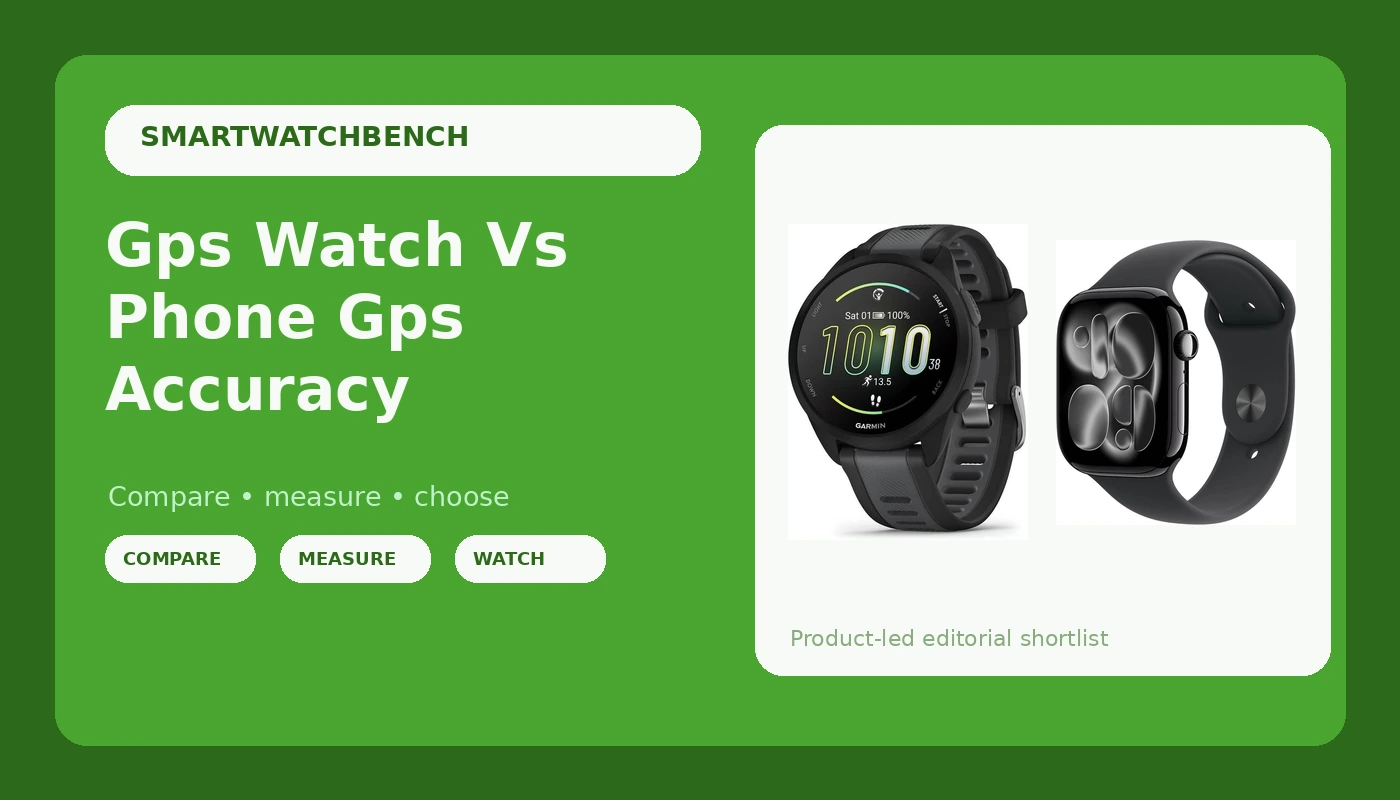
I've worn my friend's Garmin Forerunner 165, which runs ~$200. It's a beautiful piece of hardware. The GPS trace on my known course was essentially perfect, within 0.1 miles over the full 5-mile loop. My phone, a mid-range Android, gave me 5.2 miles. My ~$30 MorePro gave me 5.1.
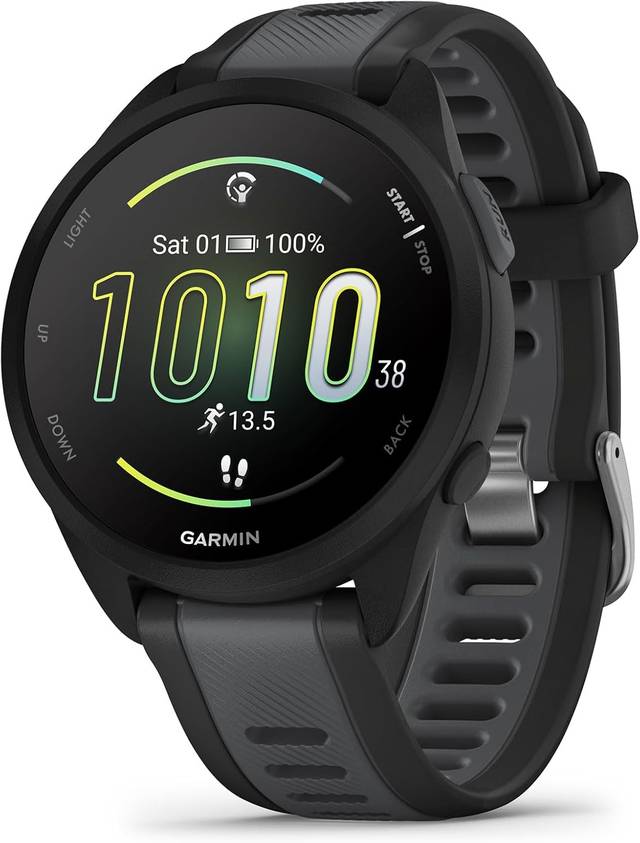
So the Garmin cost 15 times more than the MorePro and was 0.1 miles more accurate on a single run. That's not nothing. If you're doing serious interval training where a few seconds per mile matters, that 0.1 becomes a training zone question.
But for the average person who wants to know if they ran three miles or three and a half? The cheap watch and the phone are both close enough that the difference won't change your life.
The Apple Watch sits in a weird middle spot. It's more accurate than my phone in most conditions, but it's still not a dedicated running watch. I've seen it struggle with GPS lock when you start a run from indoors, and the battery drain during a marathon-length workout is real. You're paying ~$312.55 for a watch that does a lot of things, but none of them as well as a dedicated device.
![Apple Watch Series 11 [GPS 46mm] Smartwatch with Jet Black Aluminum Case with Black Sport Band - M/L. Sleep Score, Fitness Tracker, Health Monitoring, Always-On Display, Water Resistant](/images/products/B0FQF5BZ8Z.jpg)
GPS accuracy
I've run my benchmark course, a marked 5-mile loop with a few sections of tree cover and one stretch along a busy road, more times than I can count. It's my constant. Every watch I review gets compared against it.
The phone did fine on the open stretches. It held a consistent line and reported my splits within a few seconds of my known pace. The trouble started under the trees. There's a half-mile section along a creek where the canopy gets thick, and my phone's GPS started wandering.
It showed me running a zigzag pattern that I absolutely did not run. By the time I hit the road again, it had added 0.2 miles of phantom distance.
The MorePro handled the same section better. Not perfect, but the trace was cleaner. It added maybe 0.05 miles over the same stretch. I've had this watch for six weeks now and the GPS consistency is the reason I keep reaching for it instead of my phone.
The Garmin was the only device that gave me a trace I couldn't find fault with. Spot on, mile after mile.
Here's the thing about phone GPS though. It's gotten dramatically better in the last few years. The old reputation for phones being wildly inaccurate comes from the days of standalone GPS chips. Modern phones use a combination of GPS, GLONASS, and cellular tower triangulation.
On open roads, the difference between my phone and my cheap watch was negligible. One run, both said 5.1 miles.
The phone just took longer to lock onto the signal at the start.
Heart rate and pace data
This is where the phone falls apart completely. A phone can tell you distance and pace, but it can't track your heart rate. If you're training by effort, if you're doing zone work, if you're trying to figure out if you're overtraining, you need a watch with an optical sensor.
I compared my MorePro against my chest strap, which I trust completely. The watch was off by an average of 3 beats per minute during a tempo run. That's within the margin I consider acceptable for training purposes. The Garmin was off by 2. My phone couldn't even participate in this test.
The other thing the phone can't do is give you real-time pace without looking at it. I run with my phone in a belt, and checking my pace means stopping or contorting my arm to see the screen. The watch is right there on my wrist. I glance down, I know where I am. That alone is worth the ~$30.
Battery and real-world use
My phone drops about 15% battery during an hour-long run with GPS active. That doesn't sound like much, but when I'm training for a fall marathon and doing two-a-days, that adds up. I've come home from a long run with my phone at 40% and no way to charge it before my next shift at the garden center.
The MorePro used about 8% during the same run. And it charges in about 20 minutes while I'm in the shower. The Garmin used less, maybe 5%, but it takes over an hour to charge and the battery degrades noticeably over a few years of use. My friend's had his for two years and he says he's lost about 20% of his original battery life.
One thing I'll say about the phone though. It never dies on me mid-run. My watch has died twice, both times because I forgot to charge it. My phone has never let me down in the middle of a workout. That's a real consideration.
Durability and the stuff that doesn't show up in specs
I've killed a watch by dunking it in a bucket at work. I've had a band holder snap off while I was just walking. I've had a step counter silently stop counting for weeks at a time. The Garmin has been through marathons, trail runs, and a creek crossing at mile 22, and it's still going. The Apple Watch is fine for daily wear but I wouldn't take it on a muddy trail run without a case.
My MorePro has survived two months of daily wear, including a few spills at the garden center. The stock band made my wrist sweat, so I swapped it for a scrunchie band and that solved the problem. For ~$30, I'm not expecting it to last three years.
But if I get six months out of it, that's about 16 cents a day. My friend's Garmin, at ~$450 over three years, is about 41 cents a day.
The math is not as lopsided as you'd think.
Should you buy a GPS watch or just use your phone?
If you're a casual runner who does a few miles a few times a week and doesn't care about pace during the run, use your phone. It's accurate enough on open roads and it's already in your pocket. Download a free app, turn on the GPS, and go. You'll get distance, pace, and a map. That's probably all you need.
If you're training for something specific, if you're doing intervals, if you care about heart rate zones, if you're running trails or in areas with spotty cell service, buy a watch. It doesn't have to be expensive. My ~$30 MorePro gives me GPS, heart rate, and pace, and it does it without draining my phone. The Garmin does it better, but it costs 15 times more.
The honest answer is that most people fall into the first camp. They don't need a watch. But the ones who do need it, really need it. And the cheap ones, for the price, are good enough that you don't need to spend ~$400 to get the data that matters.
What I'm testing next: a ~$25 watch that showed up this week and claims 14-day battery life. I'm running my benchmark course with it this weekend. If the GPS trace is clean, it might be the new value king.