The smartwatch buying guide conversation usually starts with a spec sheet and ends with a return. You see a 1.85 inch display, 120+ sport modes, heart rate and SpO2 sensors, sleep tracking, Bluetooth calling, and a price that looks like a rounding error, and it seems like the whole category has been solved. Then you wear it for a week, the wrist heart rate spikes on the first interval session, and you start asking what you actually bought.
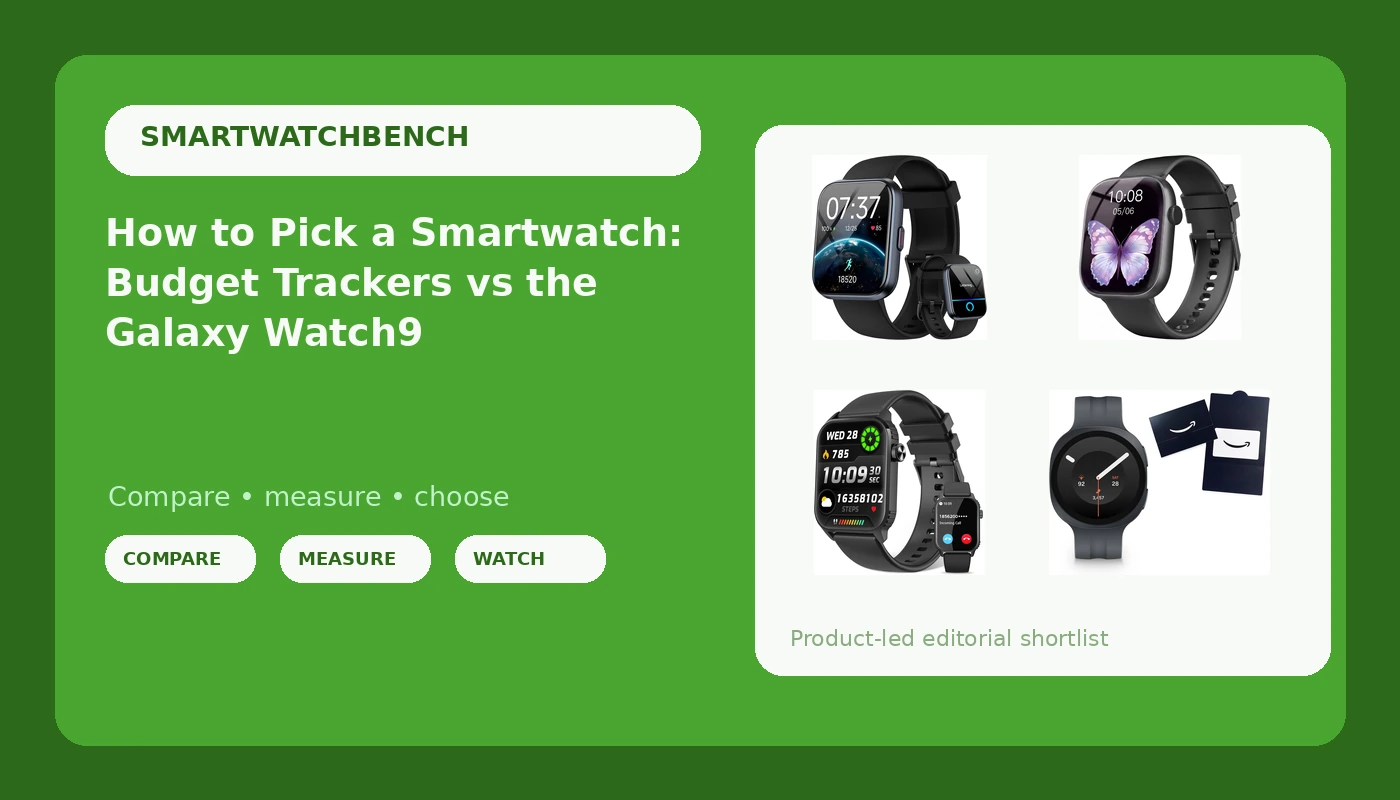
Here is the split that matters in this group of four. Three of them are budget-first designs with 1.83 to 1.85 inch screens, Bluetooth calling, and sport mode counts in the triple digits. The fourth is a Samsung Galaxy Watch9 in a 40mm graphite case with a $50 gift card bundled in, which puts it in a different price and feature tier entirely. Choosing between them is not about which one is nicer. It is about what you need the watch to do, and how much of the marketing you are willing to take on faith.
Related: How to Test GPS Accuracy on Any Running Watch →
Quick answer
All four watches can take and make calls over Bluetooth, and the three budget models pair with iPhone, Samsung, and Android phones. If you want the longest stated feature list for the least money, the 1.85 inch model with SpO2, heart rate and sleep tracking, a 3ATM rating, and Alexa built in covers the most ground. If your priority is a smaller case and a deeper app ecosystem, the Samsung Galaxy Watch9 is the one to price out, and the bundled $50 gift card is part of that math. If you mostly want notifications, calls, and a basic activity log, the 1.83 inch HD touchscreen model is the simplest entry point. If you care most about workout mode coverage, the black IP67 model with 120+ sports modes, sleep monitoring, and music control is built around that.
Four useful options
| Model | Best fit | What stands out |
|---|---|---|
| Smart Watch for Men Women, 1.85" Smart Watches Compatible iPhone/Samsung/Android (Answer/Make), Fitness Tracker with Heart Rate/Sleep/SpO2 Monitor, Smartwatch 3ATM Waterproof 120+ Sport Modes, Alexa | Buyers who want the most features per dollar | 1.85" display, heart rate, sleep and SpO2 monitoring, 3ATM rating, 120+ sport modes, Alexa built in |
| Smart Watch for Women Men, Bluetooth Answer/Make Call, 1.83" HD Touchscreen | Buyers who want a simple calling watch | 1.83" HD touchscreen and Bluetooth calling in a unisex design |
| Smart Watch for Men, 120+ Sports Modes Smartwatch with 1.83" HD Touchsreen, Sleep Monitor, IP67 Waterproof, Bluetooth Call & Music Control Fitness Watch for iPhone/Android (Black) | Buyers focused on workout mode coverage | 120+ sports modes, IP67 rating, sleep monitor, Bluetooth call and music control |
| Samsung Galaxy Watch9 + $50 GC, Graphite, 40mm Bluetooth Smartwatch | Android buyers who want a smaller premium case | 40mm graphite case, Bluetooth connectivity, $50 gift card included |
The all-rounder budget pick: Smart Watch for Men Women, 1.85" Smart Watches Compatible iPhone/Samsung/Android (Answer/Make), Fitness Tracker with Heart Rate/Sleep/SpO2 Monitor, Smartwatch 3ATM Waterproof 120+ Sport Modes, Alexa
The trade-off with a watch like this is that a longer feature list does not guarantee better numbers. SpO2 on a wrist sensor is a convenience reading, not a clinical measurement, and wrist heart rate is the sensor most likely to disappoint you the moment you start doing intervals, because optical sensors struggle to keep up with rapid changes in blood flow. None of that shows up in a product listing. If your training depends on accurate zones, budget for a chest strap and treat the watch's heart rate as a second opinion. The 3ATM rating is the other thing to read carefully: it is a pressure rating used for everyday water resistance, not a promise that the watch belongs in open water, so check the manufacturer's guidance before you swim in it.
The simple entry point: Smart Watch for Women Men, Bluetooth Answer/Make Call, 1.83" HD Touchscreen
What you give up is spelled out by what is missing from the listing. There is no stated SpO2 sensor, no stated waterproof rating, and no stated sport mode count, so if sleep staging, blood oxygen readings, or a specific water resistance class matter to you, this is not the model to gamble on. It is the right watch for someone who wants calls, messages, and a step and activity baseline on the wrist, and who would rather not pay for sensors they will never open in the app. If you are unsure whether you will actually use a smartwatch, this is the cheapest way to find out without committing to the premium tier.
The workout-mode pick: Smart Watch for Men, 120+ Sports Modes Smartwatch with 1.83" HD Touchsreen, Sleep Monitor, IP67 Waterproof, Bluetooth Call & Music Control Fitness Watch for iPhone/Android (Black)
IP67 and 3ATM get used interchangeably in marketing, and they are not the same claim. IP67 is an ingress protection rating: dust tight, and protected against temporary immersion under defined test conditions. 3ATM is a static pressure rating. Neither one is an invitation to dive, and both degrade as seals age, so if you swim or shower in a watch, follow the manufacturer's instructions rather than the number. The other thing to know about sport mode counts is that a mode is usually a preset label for how the watch displays and records a session, not proof that the watch measures that sport well. The number tells you the software has a slot for your activity. It does not tell you the GPS trace will match the course you ran.
The premium option: Samsung Galaxy Watch9 + $50 GC, Graphite, 40mm Bluetooth Smartwatch
This is where the comparison stops being apples to apples. The Galaxy Watch9 is a different class of device with a different software platform, and the listing should be read for the exact sensor suite, connectivity, and battery rating on the model you are buying, because Samsung's line varies by size and configuration. What the name tells you is the case size, the color, the connection type, and the gift card. What it does not tell you is how the watch handles your specific sport, which is why the only honest way to judge it is to compare its GPS trace and heart rate against a known course and a chest strap, the same test you would run on any watch. The $50 gift card is real value in the bundle, but it is not a discount on the watch, so compare the out-of-pocket cost against the budget models with that in mind.
Prices and availability may change. Product images, names, and retailer links must be matched by verified ASIN. Do not state a current price, rating, stock status, or measured result without current evidence.
Reading a smartwatch spec sheet without getting fooled
Display size is the easiest spec to judge and the least important to performance. A 1.85 inch screen is noticeably larger on the wrist than a 1.83 inch screen, and both are big enough for notifications and workout stats. Case size matters more than screen size if you have a narrow wrist, which is the main argument for the 40mm Galaxy Watch9 in this group.
Water ratings are the most misread spec on any listing. IP67 describes dust and water ingress protection. 3ATM describes static pressure. Neither is a depth rating for swimming, and both are tested under lab conditions, not in chlorinated pools or salt water. If water exposure is a regular part of your week, find the manufacturer's own guidance before you buy.
Sport mode counts are a software feature, not a sensor feature. A watch with 120+ modes has presets for a lot of activities, but the accuracy of any session still comes down to the GPS and heart rate hardware underneath. That is why two watches with the same mode count can produce very different training logs.
Sensor lists deserve the same skepticism. Heart rate, sleep, and SpO2 are all wrist optical measurements, and all three are more useful for spotting trends over weeks than for making decisions about a single session. SpO2 in particular is a wellness reading on consumer wearables, not a medical measurement.
Where budget watches and premium watches actually diverge
The gap is not usually the screen. It is the ecosystem. A premium watch on a mature platform gets a deeper app library, more frequent software updates, and tighter integration with the phone it was designed for. A budget watch gets a companion app that handles the basics and, in exchange, works across iPhone, Samsung, and Android without caring which one you carry.
The second gap is sensor quality and how the software handles it. Better hardware plus better filtering usually means fewer wild heart rate readings during hard efforts, and a GPS chipset that holds a line through tree cover and city streets instead of cutting corners. This is the part of the review that no spec sheet captures, and it is the reason a cheaper watch can be perfectly adequate for steady jogging and frustrating for interval work.
The third gap is longevity. Updates can add features or break them, and a watch that stops receiving updates keeps working but stops improving. If you plan to keep a watch for three or four years, platform support belongs in your decision alongside the feature list.
A five-step way to decide
- Pick your phone first. If you carry an iPhone or a non-Samsung Android, the budget watches here claim cross-platform support, which removes the compatibility question entirely.
- Name the two things you will actually use. Calls and notifications, or workout logging and sleep. Watches that do everything are not automatically better for you than watches that do your two things well.
- Check the water rating against your real week. If you swim, verify the manufacturer's guidance rather than trusting IP67 or 3ATM to cover it.
- Match the case to your wrist. A 40mm case wears very differently from a 1.85 inch display on a large body, and this is the spec you feel every hour of the day.
- Decide whether the extras change the math. A bundled gift card, SpO2, or Alexa support only matters if you will use it, otherwise it is a feature you paid for and never opened.
Practical guidance before you buy
- Budget for a chest strap if heart rate accuracy drives your training, because wrist optical sensors lag during fast changes in effort.
- Treat any GPS claim as unverified until you have seen a trace against a course you know, including on the watch you already own.
- Read the listing for what is not there. Missing SpO2 or a missing water rating is information, not an oversight.
- Check the return window before you commit, since wrist fit and notification behavior are personal and hard to judge from photos.
- Do not buy a premium watch for the ecosystem unless you will use the apps, and do not buy a budget watch expecting premium sensor filtering.
Which option should you choose?
Choose the Smart Watch for Men Women, 1.85" Smart Watches Compatible iPhone/Samsung/Android (Answer/Make), Fitness Tracker with Heart Rate/Sleep/SpO2 Monitor, Smartwatch 3ATM Waterproof 120+ Sport Modes, Alexa when you want the most features for the money and value a larger screen, SpO2, and voice assistant support. Choose the Smart Watch for Women Men, Bluetooth Answer/Make Call, 1.83" HD Touchscreen when calls and notifications are the whole job and you would rather not pay for sensors you will not use. Choose the Smart Watch for Men, 120+ Sports Modes Smartwatch with 1.83" HD Touchsreen, Sleep Monitor, IP67 Waterproof, Bluetooth Call & Music Control Fitness Watch for iPhone/Android (Black) when workout mode coverage, sleep tracking, and music control are the priorities. Choose the Samsung Galaxy Watch9 + $50 GC, Graphite, 40mm Bluetooth Smartwatch when you want a smaller 40mm case, a premium platform, and the bundled gift card.
One caveat applies to all four: nothing here substitutes for checking the current listing, because sensors, ratings, and bundle contents can change between configurations and revisions. Feature names describe what a watch is advertised to do, not how accurately it does it, and accuracy is the part you only learn by wearing it.
The bottom line
Three of these watches compete on features per dollar, and one competes on platform and case size. If your priority is covering the most ground for the least money, the 1.85 inch model with SpO2, sleep tracking, 3ATM, and Alexa support is the most complete budget option in this group. If you want the simplest possible device, the 1.83 inch HD touchscreen model keeps the scope narrow on purpose. If workout modes and music control matter most, the black IP67 model is built around that. And if you want a 40mm case, a premium ecosystem, and a $50 gift card in the box, the Galaxy Watch9 is the one to compare against the rest. Whatever you pick, judge it the way you would judge any training tool: on the trace it produces and the numbers it reports when you are working hard.