Most people shopping for a smartwatch are not choosing between good and bad. They are choosing between four or five watches that all promise the same things: accurate heart rate, long battery life, GPS that matches the road, and a screen you can read in direct sun. The real differences live in the details that never make it onto the box, which is why a smartwatch buying guide beats a spec-sheet comparison almost every time.
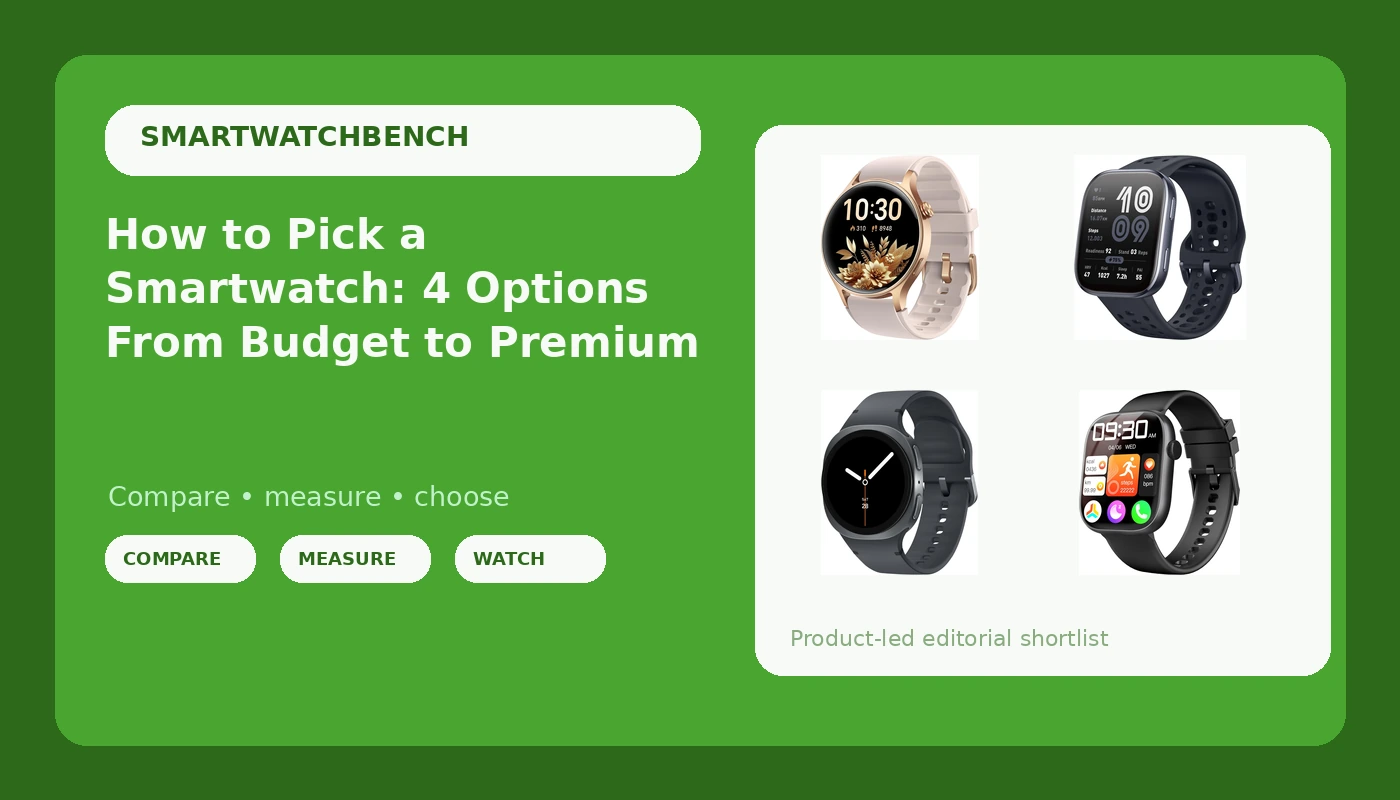
This guide covers four watches that sit at very different points on the price and feature spectrum. One is a compact AMOLED model designed for women. One is a mid-priced Amazfit with a large display and named GPS. One is a 2025 Samsung Galaxy Watch in a 40mm case. One is a budget all-rounder that costs less than a decent pair of running shoes. Each one has a different job, and none of them is the right answer for every wrist. Read the product breakdowns first, then the sections that follow, which explain how to match a watch to what you actually do with it.
Related: How GPS Accuracy Is Actually Measured in Running Watches →
Quick answer
If route tracking is the point, look hardest at the Amazfit Bip 6, the only watch in this group whose listed specs name GPS. If you want a mainstream flagship feel on Android in a smaller case, the Samsung Galaxy Watch 8 (2025) is the premium option here at 40mm. If you want the lowest entry point and can live without GPS, the 1.83-inch HD touchscreen model covers calls, steps, sleep, and multi-sport modes with an IP67 rating. The 1.32-inch AMOLED watch is the compact choice for smaller wrists and everyday notifications.
Four useful options
| Model | Best fit | What stands out |
|---|---|---|
| Smart Watch for Women, Answer/Make Call, 1.32'' AMOLED Ultra-Clear Screen | Smaller wrists, calls and notifications | 1.32-inch AMOLED screen, answer and make calls from the wrist |
| Amazfit Bip 6 Smart Watch, 1.97" AMOLED Display, GPS, iOS/Android | Runners and walkers who want GPS at a mid price | Named GPS, large 1.97-inch AMOLED panel, iOS and Android support |
| Samsung Galaxy Watch 8 (2025), Graphite, 40mm, Bluetooth Smartwatch | Android users who want a mainstream flagship | 2025 Galaxy Watch platform, 40mm graphite case, Bluetooth pairing |
| Smart Watch for Women Men, Fitness and Sleep Trackers with 1.83" HD Touchscreen, Bluetooth Calling Smartwatch for Android/iOS, IP67 Waterproof Multi-Sport Modes Pedometer, Jet Black | First smartwatch on a tight budget | 1.83-inch HD touchscreen, IP67 rating, multi-sport modes, Bluetooth calling |
Compact pick: Smart Watch for Women, Answer/Make Call, 1.32'' AMOLED Ultra-Clear Screen
The trade-off is what is not listed. This watch's specs name a display and calling, not GPS. That matters if you plan to run, ride, or hike with it, because without a GPS chip the watch cannot log a route on its own; distance and pace end up estimated from arm movement, and step-based distance estimates drift badly over anything longer than a walk. If your use case is notifications, calls, and a screen you can glance at, that trade-off costs you nothing. If your use case is a measured 10K, it costs you everything, and you should be looking at the GPS model below.
Runner's value: Amazfit Bip 6 Smart Watch, 1.97" AMOLED Display, GPS, iOS/Android
One caution before you treat GPS as a solved problem. Having a GPS chip and having accurate GPS are two different claims, and no spec sheet settles the second one. Accuracy depends on antenna placement, how the firmware handles tight turns, tree cover, and city canyons, and how aggressively the watch smooths the track afterward. A watch can list GPS and still cut corners on a switchback trail. The honest position is that GPS on the spec sheet tells you the watch is in the right category; it does not tell you the trace will match a certified course. That is something you verify over multiple runs, not over one product page.
Flagship pick: Samsung Galaxy Watch 8 (2025), Graphite, 40mm, Bluetooth Smartwatch
The trade-off here is ecosystem and connectivity, not hardware. A Bluetooth model depends on a paired phone for calls, messages, and data; it is not a standalone cellular device, so leaving the phone at home means leaving the connection behind. Samsung's watches are built to work most completely with Android phones, and the experience on other platforms is more limited. If you are on Android and want the most polished general-purpose smartwatch in this lineup, this is the one to compare against everything else. If you are chasing a personal best on a certified course, a flagship case and a bright screen are not what gets you there.
Budget pick: Smart Watch for Women Men, Fitness and Sleep Trackers with 1.83" HD Touchscreen, Bluetooth Calling Smartwatch for Android/iOS, IP67 Waterproof Multi-Sport Modes Pedometer, Jet Black
Two spec terms deserve a plain translation. IP67 means the watch is dust-tight and rated to survive temporary immersion in fresh water under defined test conditions, which covers rain, sweat, hand washing, and an accidental dunk. It is not a diving rating, it does not promise anything about salt water or high-pressure jets, and the seal can degrade with age and knocks, so do not treat it as permanent. Multi-sport modes, meanwhile, means the watch has preset activity profiles to record different workouts. It does not mean the watch has GPS, and it does not mean the heart rate sensor will match a chest strap during hard intervals. On a budget watch, treat step counts and sleep trends as the reliable core and pace data as approximate.
Prices and availability may change. Product images, names, and retailer links must be matched by verified product record. Do not state a current price, rating, stock status, or measured result without current evidence.
What actually matters when you choose a smartwatch
Five things decide whether you will still be wearing the watch in six months, and four of them are easy to check before you buy.
GPS or no GPS. If you run, ride, hike, or walk for distance, a GPS chip is the line between a training log and a guess. If you do not, it is money you can spend elsewhere. The fastest way to filter a product list is to search the specs for GPS and stop reading the ones that do not mention it.
Heart rate honesty. Wrist optical heart rate is convenient and imperfect. It tends to lag during fast changes in effort, which is exactly when intervals happen, and it struggles with cold hands and loose straps. A wrist sensor that tracks steady-state effort reasonably is still useful for resting heart rate and sleep trends. It is not the same instrument as a chest strap, and no amount of marketing changes the physics.
Battery life at real use. Battery figures are quoted at light use, which usually means notifications off and GPS off. Turn on GPS for an hour a day and always-on display, and the number drops. When you compare two watches, compare the conditions, not the headline days.
The phone in your pocket. Bluetooth calling and message replies depend on the phone platform and the app. A watch that works beautifully with Android may do less on iOS. Check compatibility before you fall in love with a case design.
Case size and band fit. A 40mm case and a 46mm case are different products on a 15cm wrist. Case size affects comfort, sleep tracking, and whether you keep the watch on overnight, which is where most of the useful data comes from anyway.
How to read the spec sheet
Vendors describe screens in ways that are not directly comparable. "AMOLED" describes the panel technology, which typically means deeper blacks and better contrast in daylight. "HD touchscreen" describes resolution without naming the panel type, so it tells you less. Neither term tells you brightness in nits, which is the number that actually predicts outdoor readability.
The same gap shows up elsewhere. A listed feature is a promise that the hardware exists; an unlisted feature is usually a sign that it does not. That is why the absence of GPS in a spec list is more informative than the presence of "multi-sport modes." One names a chip. The other names a menu.
- Decide the job first: calls and notifications, or training data. The answer eliminates half the market.
- Check for GPS if distance matters. No mention of GPS means no route logging.
- Match the water rating to your sport. IP67 handles sweat and rain; swimming and diving need a proper swim rating.
- Confirm phone compatibility for calls, messages, and app support.
- Measure your wrist and pick a case size you can wear overnight, because sleep data only exists if the watch stays on.
Practical rules that prevent a return
- Buy the category, not the brand. A budget watch with GPS beats a premium watch without it if route tracking is your goal.
- Do not trust a single run to judge GPS accuracy. Compare several traces against a course you know before drawing conclusions.
- Give any wrist heart rate sensor a fair test: snug strap, above the wrist bone, and compare it to a manual pulse during steady effort.
- Turn on the features you plan to use during the first week, so you learn the real battery drain while the return window is still open.
- Treat sleep and step counts as trends, not verdicts. One bad night of data means nothing; a month of it is a pattern.
Which option should you choose?
Choose the Smart Watch for Women, Answer/Make Call, 1.32'' AMOLED Ultra-Clear Screen when you want a compact AMOLED display for calls and notifications on a smaller wrist and route tracking is not part of your routine. Choose the Amazfit Bip 6 Smart Watch, 1.97" AMOLED Display, GPS, iOS/Android when GPS is on your must-have list and you want the largest screen here with support for either phone platform. Choose the Samsung Galaxy Watch 8 (2025), Graphite, 40mm, Bluetooth Smartwatch when you are on Android, want a mainstream flagship experience, and prefer a 40mm case over a larger one. Choose the Smart Watch for Women Men, Fitness and Sleep Trackers with 1.83" HD Touchscreen, Bluetooth Calling Smartwatch for Android/iOS, IP67 Waterproof Multi-Sport Modes Pedometer, Jet Black when you want the lowest-cost way to try a smartwatch and your priorities are steps, sleep, and calls.
One caveat applies to all four. Nothing in a product listing tells you how a watch performs on your wrist, on your routes, in your weather, with your phone. GPS traces, heart rate behavior during intervals, and real battery drain are only visible after a couple of weeks of use. Buy from a seller with a workable return window, test the features you actually care about in the first days, and let the data decide whether the watch stays.
The bottom line
The four watches here are not ranked from worst to best. They are four different answers to four different questions: a compact AMOLED watch for small wrists and calls, a GPS-equipped Amazfit for people who track distance, a 40mm Galaxy Watch 8 for Android users who want the flagship experience, and an IP67 budget model for anyone testing whether they will wear a smartwatch at all. Match the watch to the job, verify the features that matter to you during the return window, and ignore the spec-sheet adjectives that do not name actual hardware.