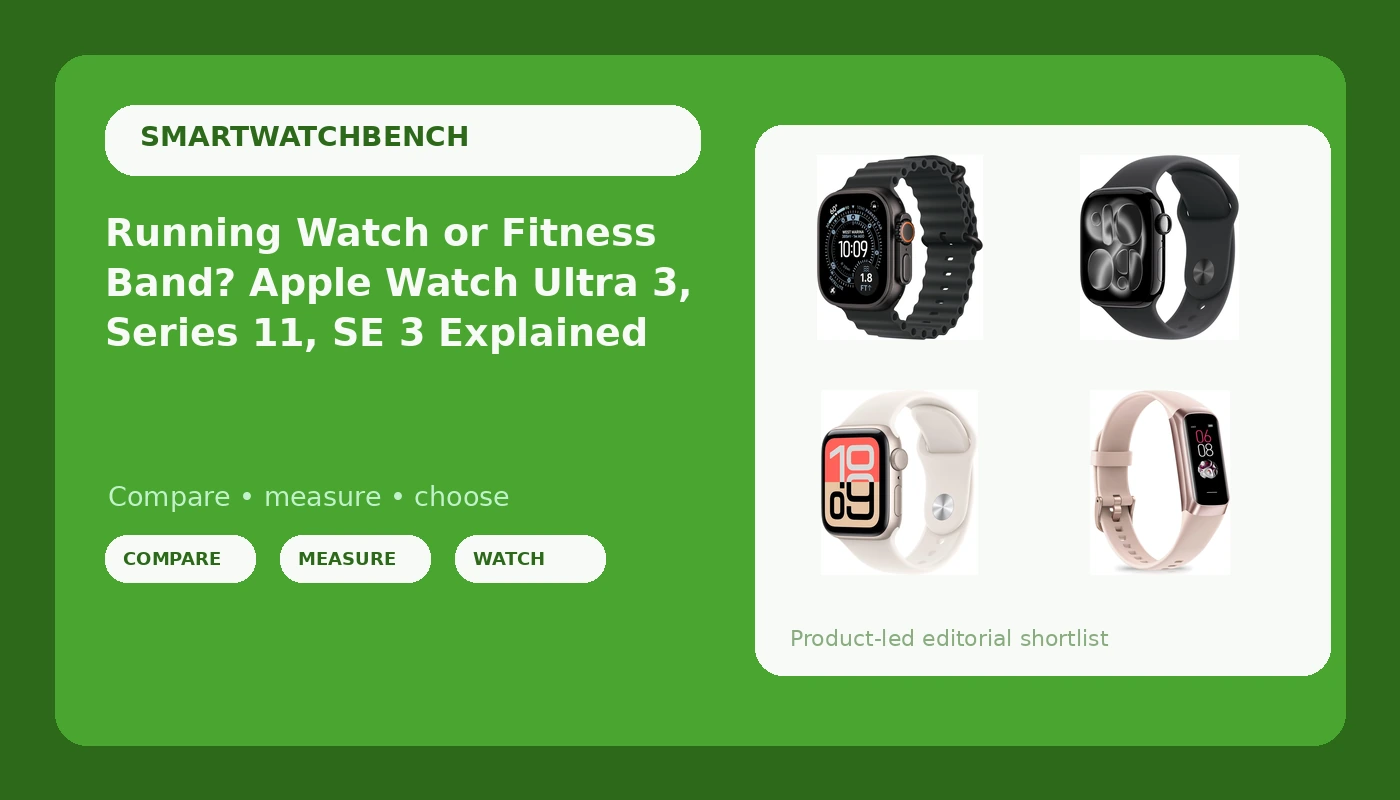
Apple Watch fitness tracking is the default answer for a lot of people who want one device for training, sleep, and notifications, but the lineup now spans three distinct tiers, and there is a fourth option sitting far below them that advertises a surprisingly similar feature list. The real question is not which spec sheet is longest. It is which watch tracks the sport you actually do, and which of the listed features you can reasonably trust with your training. This explainer walks through the four models here, what each one is built for, where the trade-offs sit, and how to decide without guessing at numbers nobody has verified.
Related: How GPS Accuracy Gets Tested Against a Known Course →
Quick answer
If you run, ride, or swim and want the most capable multisport option in this group, the Apple Watch Ultra 3 is the one listed with a rugged titanium case, cellular connectivity, and satellite communications. The Apple Watch Series 11 is the mainstream all-rounder for everyday training and health monitoring. The Apple Watch SE 3 is the entry point that keeps the core fitness and sleep tracking at a lower tier. The budget fitness tracker covers steps, heart rate, and sleep at a fraction of the cost, but its feature list deserves a careful read rather than a quick scan.
Four useful options
| Model | Best fit | What stands out |
|---|---|---|
| Apple Watch Ultra 3 [GPS + Cellular 49mm] | Multisport training and routes away from a phone | Rugged titanium case, GPS plus Cellular, satellite communications |
| Apple Watch Series 11 [GPS 42mm] | Everyday training, sleep, and health monitoring | Sleep score, always-on display, water resistance |
| Apple Watch SE 3 [GPS 40mm] | A first smartwatch with core tracking | Heart rate monitor, fitness and sleep tracking, always-on display |
| Fitness Tracker with 24/7 Heart Rate | Steps, sleep, and basic daily monitoring | 1.10-inch AMOLED screen, 24/7 heart rate, waterproof build |
The multisport option: Apple Watch Ultra 3
The Ultra 3 is the only watch here positioned for multisport use and the only one with cellular and satellite communications listed. That matters most for two kinds of people: the athlete who trains on trails, open water, or long routes where carrying a phone is impractical, and the athlete who wants a case material that stands up to contact with rock and salt water. The trade-off is size and weight. A 49mm titanium case is a large object on a smaller wrist, and it is a different experience from a 40mm band you forget you are wearing. If your training is mostly road running and gym sessions, this is more watch than the task requires.
The all-rounder: Apple Watch Series 11
The Series 11 sits in the middle of this group and, for a lot of buyers, that middle is the right place. You get the always-on display, sleep score, and water resistance without stepping up to the titanium case and cellular radio of the Ultra 3, and you get a 42mm case that wears closer to a normal watch. The catch is the GPS-only configuration. Without a cellular option listed on this model, a run means either carrying your phone or accepting that calls and messages wait until you are back. For road runners and gym-goers who train with a phone in a pocket or belt anyway, that is not much of a loss.
The entry point: Apple Watch SE 3
The SE 3 keeps the pieces most people actually use: a heart rate monitor, fitness and sleep tracking, an always-on display, and water resistance, in a 40mm case that is the smallest of the three Apple models here. What it does not list is the advanced health and fitness feature set of the Ultra 3 or the sleep score of the Series 11. If your goal is a first smartwatch, a step and workout log you will actually keep wearing, and a case size that suits a smaller wrist, this tier is where the value sits. If you have already been training with structured data and want deeper metrics, you will notice the ceiling.
The budget band: Fitness Tracker with 24/7 Heart Rate
This band sits in a completely different category, and it should be judged that way. It is a step counter, a sleep log, and a heart rate display with an AMOLED screen and a waterproof build. It does not carry the GPS, the app ecosystem, or the training metrics of the watches above it, and the blood pressure feature listed here is a wrist-based estimate rather than a medical measurement. If you want a general sense of how much you move and how you slept, and you do not want to spend watch money to get it, this covers that. If you want distance you can trust on a measured route, look higher up this list.
Prices and availability may change. Product images, names, and retailer links are matched to verified listings. No current price, rating, stock status, or measured result is stated here without current evidence.
How GPS and heart rate accuracy actually get judged
Two sensors decide whether a watch is useful for training: the GPS and the heart rate monitor. Everything else is convenience.
GPS accuracy is measured by comparing the watch's recorded trace and total distance against a route whose distance is already known, such as a certified course or a surveyed loop. A watch can look fine on an out-and-back road run and still cut corners badly on switchbacks, under tree cover, or between tall buildings, because the receiver is solving for position with weaker signals and filling gaps with software. That is why two watches with identical satellite systems can produce different numbers on the same trail. When you compare options, ask what happens on the terrain you actually train on, not on an open field.
Wrist heart rate has a different failure mode. Optical sensors read blood flow through the skin, which works reasonably well at steady effort and struggles with rapid change. During intervals, the wrist reading typically lags behind the effort, and it can lock onto your cadence instead of your pulse, which is why a hard session sometimes shows a heart rate that looks suspiciously like your step rate. A chest strap measures the electrical signal of the heart directly. If you train by heart rate zones and do interval work, treat wrist readings as a trend rather than a prescription, and expect the gap to be widest at the moments you care about most.
Reading the feature list: sleep score, always-on display, and blood pressure
Three items on these listings get misread more than any others.
An always-on display means the screen stays dimly visible instead of going black, so you can glance at the time or your pace without a wrist flick. It is a usability feature, not a tracking one, and it costs battery.
A sleep score is a summary number derived from movement, heart rate, and timing during the night. It is a compressed view of a longer record. Two people with the same score can have very different nights, so the score is a nudge, not a diagnosis.
Blood pressure on a wrist device is the one to be most careful with. Consumer wearables that list blood pressure generally produce an estimate from optical signals and are not validated for medical use the way a cuff is. If you have a blood pressure concern, a cuff and a clinician are the tools, not a watch. Treat any wrist number as a rough signal only, and never adjust medication based on it.
- Decide which sport matters most, then check whether the watch is listed for it. Multisport and open-water use point one direction; step counting points another.
- Decide whether you need cellular. If you want calls and messages without a phone, only one option here lists that capability.
- Match the case size to your wrist. A 49mm case, a 42mm case, a 40mm case, and a 1.10-inch band are four very different wear experiences.
- Separate tracking features from summary features. Raw records you can review beat a single score you cannot inspect.
- Check what you would lose by stepping down a tier, then decide whether you would actually miss it.
Matching the watch to your training week
- Write down your last four weeks of activity before you compare anything. Most buyers need less watch than they think.
- If you train on trails, in open water, or on routes without a phone, prioritize the option with the case, cellular, and satellite features listed.
- If you train on roads and carry a phone anyway, the GPS-only middle tier covers the same sessions.
- If you are buying a first watch for step counts and sleep, the entry tier or the budget band will do more than a top-tier model you stop wearing.
- If heart rate zones drive your training, budget for a chest strap regardless of which watch you pick.
Which option should you choose?
Choose the Apple Watch Ultra 3 [GPS + Cellular 49mm] when your training takes you away from your phone and you want the titanium case, cellular, and satellite capabilities listed on that model. Choose the Apple Watch Series 11 [GPS 42mm] when you want sleep score, health monitoring, and an always-on display in a mid-size case and you do not need cellular. Choose the Apple Watch SE 3 [GPS 40mm] when you want a smaller case with core heart rate, fitness, and sleep tracking as your first smartwatch. Choose the Fitness Tracker with 24/7 Heart Rate when steps, sleep, and a daily heart rate glance are the whole job and you want the lowest-cost entry.
A caveat worth stating plainly: nothing here is a statement about measured GPS error, heart rate agreement with a chest strap, or battery endurance, because no such measurements are available for this group. Those are the numbers that decide whether a watch is worth wearing for training, and they are the numbers a spec sheet cannot give you.
The bottom line
Four options, four jobs. The Ultra 3 is the multisport build with the rugged case and the connectivity extras. The Series 11 is the balanced middle that covers everyday training and health monitoring. The SE 3 is the smallest and simplest of the Apple models here. The budget fitness tracker is a step, sleep, and heart rate band that should not be mistaken for a training instrument. Pick the one whose listed capabilities match the sport you actually do, and if accuracy on distance and heart rate is what you care about most, treat the wrist numbers as a starting point and verify them against a known course and a chest strap.