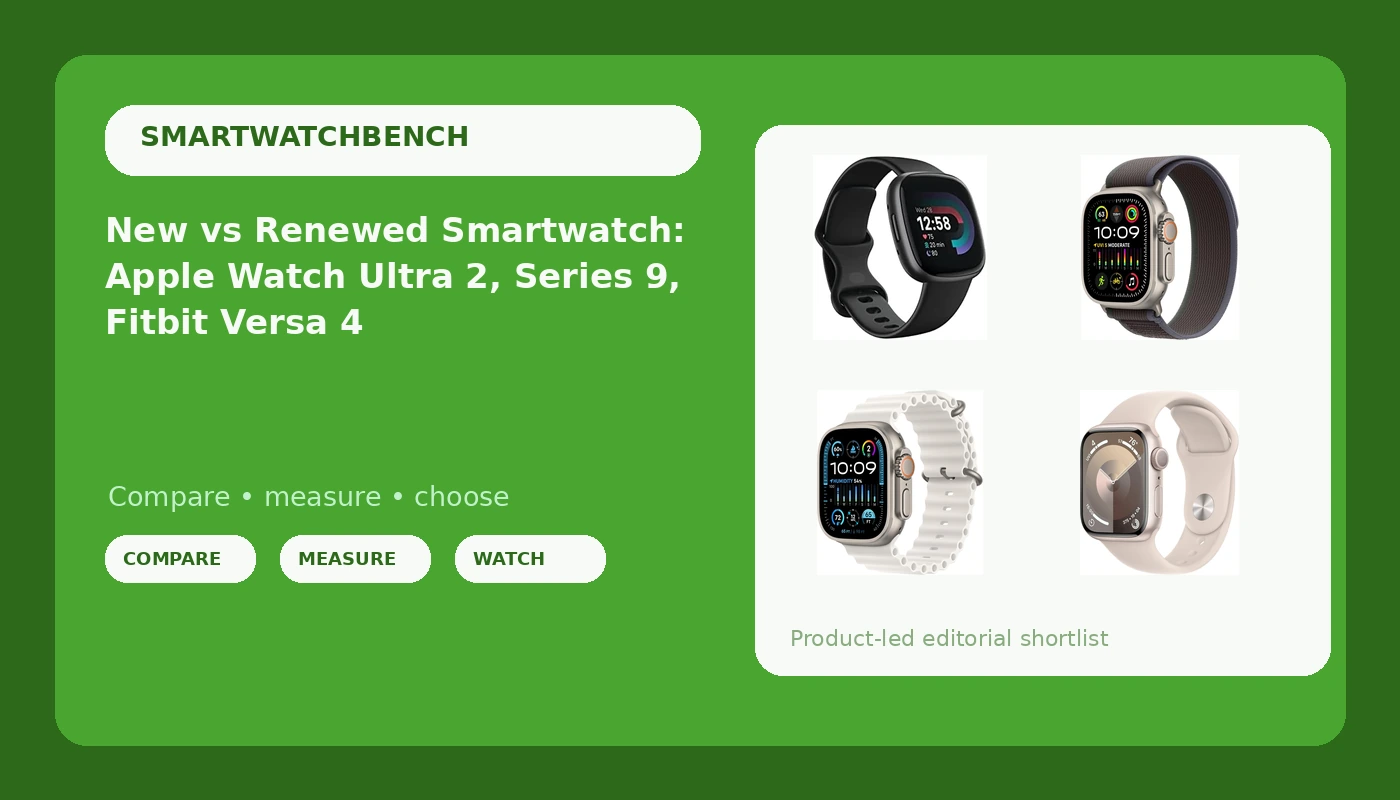
Buying a smartwatch now means answering a question that barely existed a decade ago: do you want the new model, or the same hardware sold as a renewed smartwatch? The four watches here split that question in half. Two are Apple Watch Ultra 2 units, one new and one renewed. One is a renewed Apple Watch Series 9. One is a Google Fitbit Versa 4 that does not require an iPhone at all. The product names already carry most of the hard information: case size, case material, GPS and cellular support, band type, and the sensors the manufacturer advertises. What the names do not carry is the part that actually decides the purchase, which is whether the watch fits the way you train and the phone in your pocket.
Related: How We Test GPS Accuracy in Running Watches →
Quick answer
The Apple Watch Ultra 2 is the pick if you want the largest and most rugged case in this group, GPS plus cellular in a single unit, the Action Button, and the Blue/Black Trail Loop, and you want it new. The renewed Apple Watch Ultra 2 with the White Ocean Band is the same 49mm GPS plus Cellular specification sold through a renewed listing, which is a condition difference rather than a hardware difference. The renewed Apple Watch Series 9 in 45mm is the smaller, lighter, GPS-only option for everyday wear and workouts where you are carrying a phone anyway. The Google Fitbit Versa 4 is the cross-platform option, built around 24/7 heart rate tracking and equally at home on Android or iPhone.
Four useful options
| Model | Best fit | What stands out |
|---|---|---|
| Apple Watch Ultra 2, 49mm Titanium, Blue/Black Trail Loop | Rugged training and iPhone users who want cellular on the wrist | 49mm titanium case, GPS + Cellular, Action Button, precision GPS, extra-long battery life as described in the listing |
| Apple Watch Ultra 2, 49mm Titanium, White Ocean Band (Renewed) | Buyers who want the Ultra 2 specification through a renewed listing | Same 49mm GPS + Cellular spec, titanium case, Ocean Band, renewed condition |
| Apple Watch Series 9, 45mm Starlight Aluminum, Starlight Sport Band (Renewed) | Everyday wear and GPS workouts with a phone nearby | Smaller 45mm aluminum case, GPS only, Sport Band in size S/M, renewed condition |
| Google Fitbit Versa 4, Black/Graphite | Android users and mixed-phone households | 24/7 heart rate tracking, works with Android and iPhone, no Apple device required |
The rugged flagship: Apple Watch Ultra 2
The trade-off with the Ultra 2 is size and ecosystem. A 49mm titanium case is a lot of watch on a smaller wrist, and the trail loop band is designed to sit snug for movement rather than to disappear under a shirt cuff. Cellular also means a separate line on your carrier plan if you want to leave the phone behind, which is an ongoing cost rather than a one-time one. And like every Apple Watch, it pairs with an iPhone. If you carry an Android phone, this watch is not on the table, no matter how good the hardware is.
The same watch, renewed: Apple Watch Ultra 2 with White Ocean Band
The Ocean Band is the other difference worth thinking about. It is a single-size band built for water and heavy movement, and it fits differently from the Trail Loop, which adjusts with a pull tab. If you swim or sweat heavily, the Ocean Band is the more obvious match. If you want a dialed-in fit for intervals, the loop style is easier to tune mid-run. Neither band changes the watch underneath, so the renewed decision comes down to how comfortable you are buying hardware that someone else has worn.
The everyday Apple Watch: Apple Watch Series 9, 45mm
Aluminum is lighter than titanium, and a 45mm case is meaningfully smaller than a 49mm one, so this is the watch in the group that disappears on the wrist most easily. That matters more than spec sheets suggest if you wear a watch to sleep or under a dress shirt. The cost of that comfort is durability and the missing cellular option. Aluminum scratches and dents more readily than titanium, and the Sport Band is a simple, functional strap rather than a rugged one.
The cross-platform option: Google Fitbit Versa 4
What you give up is the cellular option and the deeper Apple health integration. What you get is a watch that keeps working if you change phones, which is a real consideration over a multi-year ownership window. The 24/7 heart rate wording is the manufacturer's description, and continuous optical heart rate is the sensor type that struggles most with rapid changes in intensity, so treat any wrist-based heart rate number during intervals as an estimate until you have compared it against a chest strap on your own runs.
Prices and availability may change. Product images, names, and retailer links must be matched by verified ASIN. Do not state a current price, rating, stock status, or measured result without current evidence.
What "renewed" actually means for a smartwatch
Renewed is not a single standard. It is a label sellers apply to hardware that has been owned before and then inspected, cleaned, and resold. Depending on the seller, a renewed watch may arrive with a third-party charger instead of the original, may show cosmetic wear on the case or display, and may carry a warranty that runs for a different length than a new unit. None of that is automatically bad, but it does mean the listing terms are part of the product, not fine print.
For a watch specifically, there are three things to check before buying renewed. First, battery health. A smartwatch battery degrades with charge cycles, and a renewed unit has already spent time on someone's wrist. Second, water resistance. Seals can be compromised if a case has been opened for repair, and a watch sold as water resistant may not behave that way after a third-party service. Third, band and charger completeness, because replacement bands and charging cables add up quickly if they are missing.
The upside is straightforward: renewed listings for the same model number give you the same sensors, the same case size, and the same software support as the new version. If you are comfortable with a cosmetic risk and you confirm the seller's return window and warranty terms, renewed is a legitimate way to get flagship hardware. If you are not comfortable with that, buy new and skip the uncertainty.
What the names tell you, and what they do not
The product names in this comparison are unusually informative, and it is worth reading them the way a spec sheet should be read. "GPS + Cellular" tells you the watch has its own radio and can work without a phone nearby, at the cost of a carrier plan. "GPS" alone tells you the watch needs a paired phone for connectivity but still records position on its own. "49mm" and "45mm" are case sizes, and case size drives weight and wrist presence more than any other single number. "Titanium" and "aluminum" are the case materials, and titanium is the more scratch-resistant and more expensive of the two.
What the names do not tell you is the part that determines whether the data is any good. Nothing in a product title tells you how a watch's GPS trace handles switchbacks, tree cover, or city blocks, and nothing in a title tells you how the optical heart rate sensor behaves when you go from easy pace to hard effort in twenty seconds. Those are the two measurements that decide whether a training watch is trustworthy, and both of them have to be verified on your own routes against your own reference. Battery life is the third: manufacturer figures are typically quoted under conditions you will not replicate, so the honest approach is to wear the watch normally for a week with GPS and notifications on and see where it lands.
Here is a practical way to work through the decision:
- Decide whether you need cellular. If you never run without a phone, GPS-only saves you money and a monthly line.
- Match case size to your wrist. A 49mm case is a different experience from a 45mm one, and both are different from what a spec page implies.
- Pick your phone first. Apple Watch requires an iPhone, so Android users should start with the Versa 4 and work from there.
- Decide how you feel about renewed hardware. If a cosmetic mark or a third-party charger would bother you, pay for new.
- Plan a verification week. Wear the watch on routes you already know and compare distance and heart rate against a reference before you trust the numbers.
Practical guidance before you buy
- Check the seller's return window on any renewed listing, and confirm the warranty length in writing before ordering.
- Confirm which band size you are buying. Trail Loop S/M, Ocean Band one size, and Sport Band S/M are not interchangeable fits.
- Budget for accessories you may need separately, including a spare charging cable and any band you plan to swap in for racing.
- Plan on a carrier plan if you choose a cellular model and intend to leave your phone behind.
- Give any new watch a two-week adjustment period before judging comfort, because wrist fit changes as the band breaks in.
- Compare wrist heart rate against a chest strap on at least a few hard sessions before you build training decisions on it.
Which option should you choose?
Choose the Apple Watch Ultra 2 when you want the 49mm titanium case, GPS and cellular in one unit, the Action Button, and the Blue/Black Trail Loop, and you would rather buy new. Choose the Apple Watch Ultra 2 with White Ocean Band (Renewed) when you want that same 49mm GPS and Cellular specification and the Ocean Band suits your swimming or heavy-sweat use, and you are comfortable with renewed condition. Choose the Apple Watch Series 9, 45mm (Renewed) when a smaller, lighter aluminum case matters more than cellular, and you usually carry your phone on runs anyway. Choose the Google Fitbit Versa 4 when you carry an Android phone, share a household across two platforms, or want 24/7 heart rate tracking without committing to Apple.
One caveat applies to all four. Nothing in these listings establishes GPS accuracy, heart rate accuracy under hard efforts, or real-world battery life, and none of those can be settled by a product title. Renewed condition is also seller-specific, so two listings for the same model can arrive in very different shape with very different warranty terms.
The bottom line
The real decision here is not which watch is fastest or toughest. It is three separate choices stacked on top of each other: Apple or cross-platform, cellular or GPS-only, and new or renewed. Answer those in order and the field narrows to one. iPhone users who want maximum case size, cellular independence, and the Action Button land on the new Apple Watch Ultra 2, with the renewed Ultra 2 as the same hardware through a different listing. iPhone users who want a lighter everyday watch land on the renewed Series 9. Android users, and anyone who wants to keep their options open, land on the Fitbit Versa 4. Whichever you pick, verify the GPS trace and the heart rate against your own reference before you let the numbers drive your training.