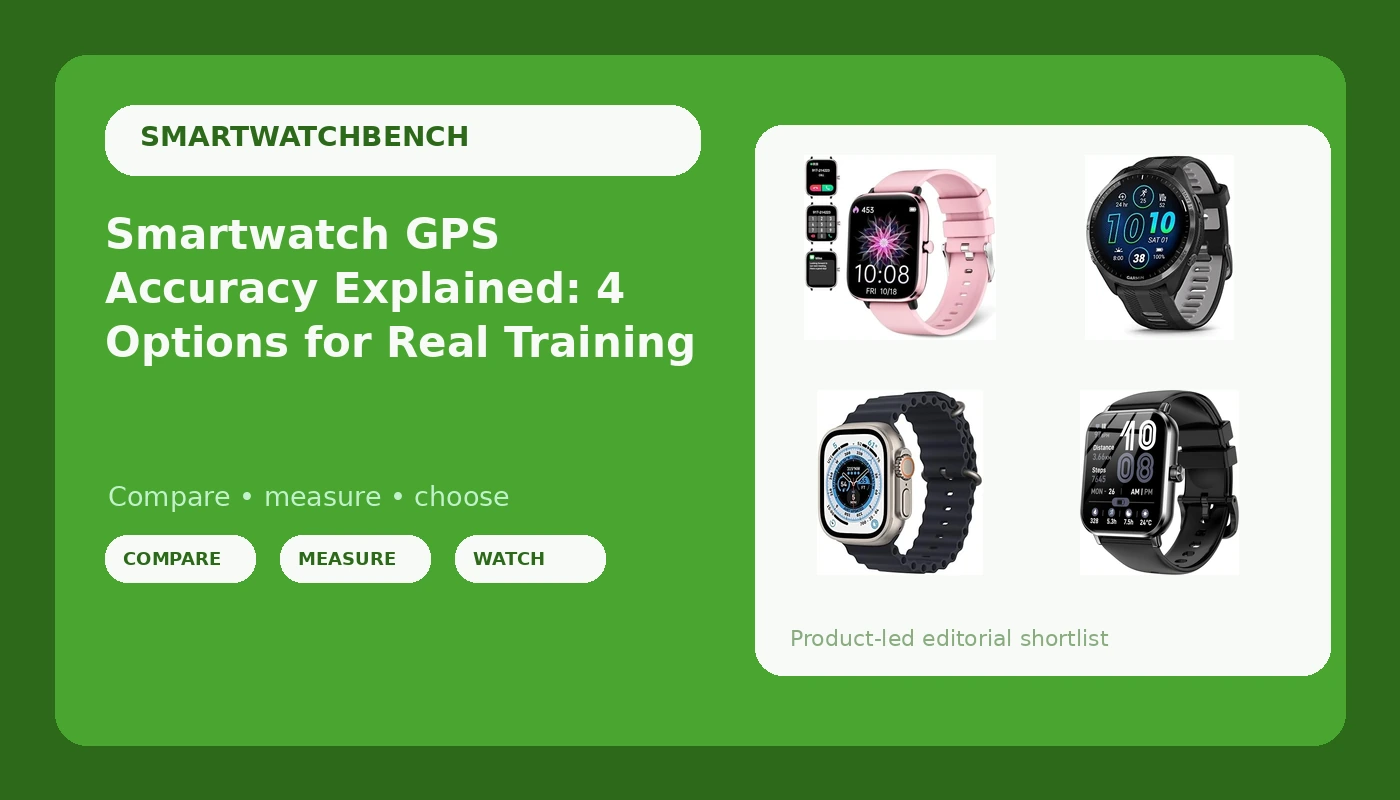
Every runner eventually has the same argument with their watch. You finish a route you have run a hundred times and the distance reads long, or short, or the map trace wanders through a neighborhood you never entered. Smartwatch GPS accuracy is the reason, and it is the single most useful thing to understand before you spend money on a wearable. A watch that holds a satellite lock through tree cover and samples position cleanly gives you usable pace, usable training load, and a usable race plan. A watch that cuts corners gives you numbers that look precise and are not. This explainer covers four very different options and, more importantly, the questions that separate them.
Related: Why Wearable Battery Claims Never Match Real Use →
Quick answer
There is no single right answer here, because these four watches are built for different jobs. If your priority is running and structured training, the Garmin Forerunner 965 is the most purpose-built option in this group. If you want the widest feature set and phone-free connectivity, the Apple Watch Ultra (Renewed) covers that ground with GPS and cellular in a 49mm titanium case. If you want calls, notifications, and basic fitness tracking without spending much, the two budget models, the 1.83-inch Smart Watch for Men Women and the pink 1.69-inch Smartwatch for Women, are the practical entry points. Match the watch to your primary activity first, then worry about everything else.
Four useful options
| Model | Best fit | What stands out |
|---|---|---|
| Garmin Forerunner 965, 47mm | Runners and triathletes | A running-specific smartwatch in a 47mm case |
| Apple Watch Ultra, 49mm Titanium (Renewed) | All-day wear with cellular | GPS + Cellular in a titanium case, renewed listing |
| Smart Watch for Men Women, 1.83" | Budget do-everything | 1.83" HD touchscreen, Bluetooth calls, IP68, 140+ sport modes |
| Smartwatch for Women, 1.69" Pink | Slim everyday tracking | 1.69" touchscreen with calls, heart rate, and sleep monitoring |
The accuracy-first pick: Garmin Forerunner® 965, Running Smartwatch, 47mm, Black/Powder Gray
The trade-off with a running-first watch is that you are buying into an ecosystem organized around training data. That is a feature if you already think in terms of pace, splits, and structured workouts, and friction if you mostly want a wrist that mirrors your phone. The other thing to keep in mind is that a 47mm case is a real presence on the wrist, so try to see one in person if you have a smaller frame. GPS performance in this class depends heavily on where you run: open roads and bike paths are easy, while dense downtown blocks and deep canyon trails are where any watch gets tested.
The all-rounder: Apple Watch Ultra [GPS + Cellular 49mm] Titanium Case with Midnight Ocean Band, One Size (Renewed)
Two things matter most when you buy renewed. First, confirm what the seller includes: band, charger, and any remaining coverage vary from listing to listing. Second, decide whether cellular is worth paying for. It is genuinely useful if you want to leave your phone behind on runs and still take calls or stream music, and it is dead weight if you always carry a phone anyway. On the fitness side, a watch like this is strongest as a daily device that also happens to track activity, which is a different design goal than a watch engineered purely around pace and distance.
The budget do-everything: Smart Watch for Men Women, 1.83" HD Touch Screen with Bluetooth Call, IP68 Waterproof, 140+ Sport Modes, Fitness Tracker with Heart Rate & Sleep Monitor, Pedometer, Compatible with Android iPhone
This is where expectations matter most. A watch in this bracket is a step counter, notification screen, and call handset that also records workouts. The feature list is long because features are cheap to list, while satellite hardware and optical sensor quality are not. Treat the workout data as directional: useful for spotting trends in your week, not for pacing a goal race. If you want a second opinion on the numbers, a chest strap paired with a phone app costs less than moving up a watch tier and gives you a more reliable heart rate signal.
The slim everyday tracker: Smartwatch for Women - Call, Fitness Tracker, Heart Rate & Sleep Monitor, 1.69" Touch Screen, Waterproof - For Android & iPhone, Pink
The 1.69-inch screen is the practical difference here. A smaller display means fewer characters per notification and a lighter look on a narrow wrist, which is exactly what a lot of buyers want from a daily wear watch. The same caveat as the other budget option applies: the sensors are there, the accuracy is not guaranteed, and the value comes from consistency of wear rather than from precision. If you wear it every day, sleep and step trends become meaningful. If you wear it twice a week, they do not.
Prices and availability may change. Product images, names, and retailer links are matched to verified listings. No current price, rating, stock status, or measured result is stated here without current evidence.
What smartwatch GPS accuracy actually means
GPS accuracy is not one number. It is the result of three things working together: how many satellites the watch can see, how well its antenna holds that signal when you move, and how the software decides what to do with noisy data.
A watch records a position fix at intervals, then connects those points into a line. If the fixes are good and frequent, the line follows the road. If the fixes drift, the software has to guess, and most watches guess by smoothing. Smoothing is why a watch can show a tidy-looking route that quietly cuts the inside of every switchback on a trail. Your total distance comes out short, and your pace comes out faster than reality.
The environment does more damage than the hardware in most cases. Open sky is easy. Tree canopy, tall buildings, and canyon walls reflect and block signals. A watch that performs well on a canal path can look mediocre in a city center, and that is true across price brackets.
The practical test is simple and free. Run a route whose distance you already know, ideally a measured course, then look at the map trace rather than the summary number. Zoom in on the corners. If the line cuts across a field or through a building, you know how much to trust the pace.
Why wrist heart rate lags a chest strap
Wrist heart rate is optical. A light shines into the skin and the sensor watches for changes in blood flow. A chest strap is electrical: it measures the actual signal your heart generates. Those are different measurement methods, and they fail in different ways.
Optical sensors struggle with motion. Every arm swing shifts the sensor against the skin, and the algorithm has to separate your pulse from the movement. During steady running this is usually fine. During intervals, when your heart rate climbs and falls within seconds, the wrist sensor is often a few seconds behind, and it can lock onto your cadence instead of your pulse.
Fit matters more than people expect. A loose band lets light leak in. A band worn too high or too low misses the artery. Cold hands reduce blood flow at the surface and make the reading worse.
If heart rate zones drive your training, treat the wrist number as a convenience and use a chest strap for the sessions where precision counts. If you are tracking general trends over months, wrist data is good enough to show direction.
- Name the one activity you do most, and buy for that. Running, lifting, and casual walking reward different designs.
- Decide whether you need to leave your phone behind. If yes, cellular connectivity is a requirement, not a nice-to-have.
- Measure your wrist and match the case. A 47mm or 49mm case is a lot of watch on a narrow wrist.
- Set a realistic charging expectation. Screens, GPS, and always-on displays all draw power, so decide how often you are willing to plug in.
- Pick the ecosystem you already live in. A watch that fights your phone is a watch you will stop wearing.
How to read a smartwatch spec sheet
- Treat the sport mode count as a menu, not a capability. More modes do not mean better tracking.
- Water resistance ratings describe pressure tolerance, not suitability for every activity.
- "Compatible with Android and iPhone" tells you the app exists, not that every feature works identically on both.
- Screen size and battery life pull against each other. A bigger display is easier to read and harder to keep charged.
- Renewed listings are a condition question, not a performance question. Read what the seller includes.
Which option should you choose?
Choose the Garmin Forerunner® 965, Running Smartwatch, 47mm when running is the point and you want a watch designed around training. Choose the Apple Watch Ultra [GPS + Cellular 49mm] Titanium Case with Midnight Ocean Band when you want one device for daily life and workouts, you value cellular connectivity, and a renewed unit is acceptable to you. Choose the Smart Watch for Men Women, 1.83" HD Touch Screen when you want the biggest screen and the longest feature list at the lowest commitment. Choose the Smartwatch for Women, 1.69" Touch Screen in Pink when a smaller case and a lighter look matter more than maximum display area.
One caveat applies to all four. Nothing in a product listing tells you how a watch will perform on your routes. Case size, sensor behavior, and GPS reception all vary with the person wearing it and the place they train, so the honest advice is to buy from a seller with a return window and test the watch on your own loop before you commit.
The bottom line
The four watches here sit at very different points on the price and purpose spectrum, and that is the useful part. The Forerunner 965 is the option built for runners who care about the trace. The Apple Watch Ultra adds cellular and a titanium case for people who want one watch to do everything. The two budget models cover calls, notifications, sleep, and steps for buyers who want the basics without the spend.
Whichever you pick, judge it the same way: check the map trace against a route you know, compare the heart rate against a strap when it matters, and pay attention to how often you actually have to charge it. Those three checks tell you more than any spec sheet, and they cost nothing but a few runs.