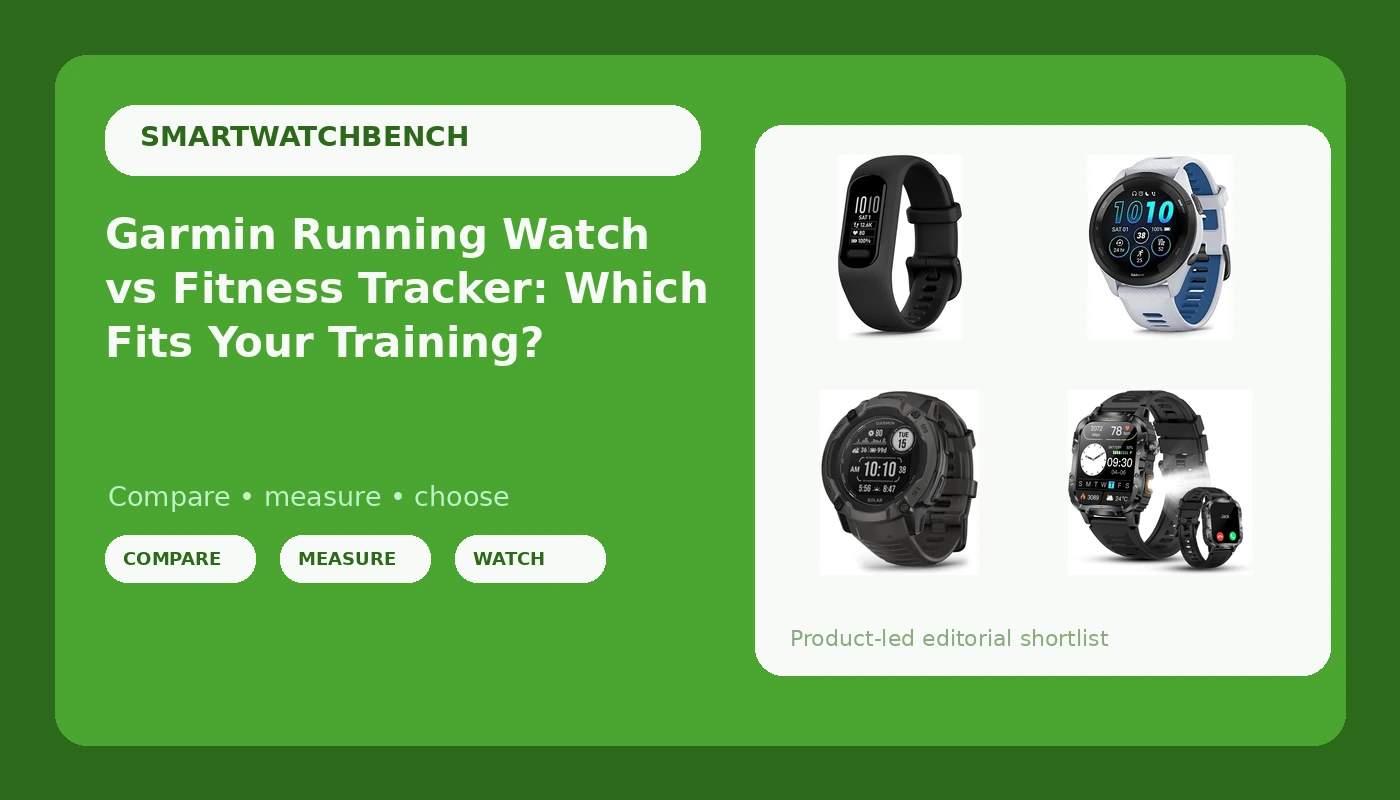
The choice between a running smartwatch and fitness tracker looks like a spec-sheet argument until you start training with the wrong one. A watch built for running has to hold a GPS fix under tree cover, sample heart rate fast enough to catch the start of an interval, and survive a long session without asking for a charger. A tracker built for daily wear has to disappear on your wrist, report sleep and steps, and last days between charges. Those are different engineering goals, and no single device does both equally well. The four wearables below sit at four points on that spectrum: a running-first Garmin, a solar-charged outdoor unit, a slim Garmin tracker, and a budget Bluetooth-call watch. Knowing which job you are actually hiring the watch for is the whole decision.
Related: How GPS Accuracy Is Measured on Running Watches →
Quick answer
If you run and want the software built around running, the Garmin Forerunner 265 is the direct answer. If you spend your time on trails, in weather, or on job sites, the Garmin Instinct 2X Solar is built for that kind of abuse and adds a solar charging lens. If you want a slim band for steps, sleep, and daily heart rate without a training platform, the Garmin vívosmart 5 covers it. If Bluetooth calling and a multi-week battery claim matter more to you than sport accuracy, the Military Smart Watch for Men leads with exactly those two things. Match the watch to your weekly routine, not to the longest feature list.
Four useful options
| Model | Best fit | What stands out |
|---|---|---|
| Garmin Forerunner 265 | Runners who train with pace, zones, and recovery | Garmin's running-focused line in a 46mm case with training metrics |
| Garmin Instinct 2X Solar | Trail runners, hikers, outdoor work | Solar charging lens and a rugged 50mm case |
| Garmin vívosmart 5 | Everyday tracking in a slim band | Health and fitness tracking in an S-M size |
| Military Smart Watch for Men | Calls and long stretches between charges | Listing claims 30+ day battery life and Bluetooth calling |
The runner's option: Garmin Forerunner 265
The case for the Forerunner 265 is not that it does everything. It is that Garmin structures the software around training, so load, recovery, and race predictions are first-class features rather than add-ons bolted onto a general-purpose watch. The trade-off is battery discipline. A bright display and frequent GPS sessions cost charge, and battery figures published for any watch assume a particular mix of use. Ask how many GPS hours you get per charge rather than how many days between charges, because those two numbers describe very different owners.
The outdoor option: Garmin Instinct 2X Solar
The Instinct 2X Solar answers a different question: what happens when the watch takes the hit instead of you. Solar charging changes the shape of your charging habit rather than replacing it, since sunlight adds to the battery over the course of a day but does not make the charger obsolete. The 50mm case is the part people underestimate. It is genuinely large on a smaller wrist, and a watch that feels bulky gets left in a drawer, which is worse than any spec shortfall.
The everyday tracker: Garmin vívosmart 5
The vívosmart 5 is the one to buy when the goal is awareness rather than training. It has no built-in GPS, so outdoor distance depends on a connected phone, which is fine for walks and casual jogs and limiting for anyone chasing a personal best. In exchange you get a band light enough to sleep in and a battery that behaves like a watch rather than a phone. If your questions are "how did I sleep" and "how much did I move," this class of device answers them without a subscription or a training plan.
The budget communicator: Military Smart Watch for Men
Read the feature list in order and the priorities are clear: calling first, battery second, fitness somewhere after. That is a legitimate set of priorities for someone who wants a phone companion on their wrist, and it is the wrong set for someone who wants to know whether their easy pace is actually easy. The battery claim in the name is a claim, not a measured result, and the honest way to evaluate it is to check how the figure is defined and what turns off when the watch is used hard.
Prices and availability may change. Product images, names, and retailer links are matched to verified listings. No current price, rating, stock status, or measured result is stated here without current evidence.
What GPS accuracy really measures
GPS accuracy is not the same thing as a smooth-looking map line. Two watches can cover the same course and disagree, and the device with the prettier trace is not automatically the correct one. A trace that looks confident can be a trace that cut the corner.
Three things separate them. The first is satellite reception. A watch that listens to more constellations and more frequencies has more data to resolve your position, which matters most in canyons, dense tree cover, and city streets where signals bounce off buildings. Multi-band reception, where the watch listens on more than one frequency, is the feature Garmin lists on its higher-end running models for exactly that reason.
The second is how the watch handles uncertainty. When signal quality drops, some devices keep drawing a confident line and quietly trim the distance. A trail runner should care about this more than a road runner, because a corner cut on a switchback can remove real climbing from your day.
The third is sampling. A watch that records a point every second captures the shape of a tight turn, while less frequent sampling smooths it away. The practical test is to run a route whose distance you already know, on a measured loop or a certified course, and compare recorded distance across several runs rather than trusting a single one.
Why wrist heart rate decides the purchase
Optical wrist heart rate is the most convenient sensor on any watch and the one most likely to mislead you. The sensor shines light into your skin and reads changes in blood flow. That works well at steady effort and struggles at the moments runners care about most: the opening seconds of an interval, cold mornings when blood flow at the wrist drops, and any time your arm swings in rhythm with your stride, which can make the sensor report cadence instead of pulse.
A chest strap measures the electrical signal of your heart, which is why it is the reference point for training zones. Wrist heart rate is not useless. For easy runs, sleep, and all-day resting heart rate, it is informative enough. For intervals and hill repeats, the lag matters, because a reading that catches up well into the effort has already missed the part you wanted to measure.
So when you compare watches, ask what the heart rate sensor is for. If you train by pace and use heart rate as context, wrist is fine. If your plan is built on zones, budget for a chest strap and treat the wrist sensor as a backup.
- Write down the sport you actually do most weeks, not the one you plan to start.
- Decide whether you need built-in GPS or whether a phone-connected tracker is enough.
- Read the battery claim and find out what use pattern it assumes.
- Decide whether wrist heart rate alone is enough or whether you will pair a chest strap.
- Match case size and build to the conditions you train in, then buy.
Matching the watch to the week you actually have
- If your week is intervals, tempo runs, and a long run, prioritize GPS quality and training metrics over display polish.
- If your week is dog walks and yard work, a slim tracker with no built-in GPS is the more comfortable choice.
- If your routes leave the pavement, weight rugged construction and multi-band positioning higher than screen brightness.
- If you mainly want calls and notifications, buy for battery and screen size and treat fitness numbers as a bonus.
- If you train by heart rate zones, price a chest strap into the decision from the start rather than after the first confusing interval session.
Which option should you choose?
Choose the Garmin Forerunner 265 when running is the sport you train for and you want the metrics and positioning built around it. Choose the Garmin Instinct 2X Solar when your training happens outdoors in rough conditions and solar charging plus a rugged case matter more than a slim profile. Choose the Garmin vívosmart 5 when you want daily health and fitness awareness in a band you forget you are wearing. Choose the Military Smart Watch for Men when Bluetooth calling and long battery life between charges are the features you will actually use.
One caveat applies to all four. Published battery figures, battery claims in product names, and GPS behavior are manufacturer statements until they are checked against your own routes and your own charging habits. The only test that settles it is a measured loop, a chest strap, and a real-use charge cycle.
The bottom line
The right pick comes down to which problem you are solving. A running smartwatch is judged on GPS consistency, heart rate behavior during hard efforts, and GPS hours per charge. A fitness tracker is judged on comfort, sleep data, and how rarely it needs a charger. The Forerunner 265 sits firmly in the first category, the Instinct 2X Solar trades slimness for durability and solar top-ups, the vívosmart 5 covers the daily basics without pretending to be a training tool, and the Military Smart Watch for Men is a calling and battery device first. Buy for the sport you do on an average Tuesday, and check current Amazon price on the listing before you commit.